

Creating a successful business online has gone beyond the need to simply put up ads or send out e-mails. Consumers nowadays like to do research, compare different products, read reviews, and consume valuable content prior to buying anything. And because of this change in consumer behavior, Inbound Marketing Strategy has become one of the most effective ways to attract prospects and turn them into loyal customers.
In contrast to traditional marketing, where companies interrupt consumers with ads, Inbound Marketing is all about giving valuable content that will help them solve certain problems or make certain decisions. By continuously educating your audience, companies build trust and relationships rather than just closing deals.
It does not matter whether you are a startup, an SME, or an enterprise business having a well-structured inbound strategy can be of great value to your business.
Key Takeaways
- Sharing valuable and informative content helps organizations attract qualified prospects and build lasting customer relationships.
- Knowing your ideal customers is the key to building a successful inbound marketing approach.
- Providing your customers with relevant content will increase trust and visibility online.
- Companies that concentrate on providing long-term benefits usually have better quality leads.
- Regular analysis and optimization of marketing campaigns bring good results.
Table of Contents
- What Is an Inbound Marketing Strategy?
- Why Is Inbound Marketing Important?
- Benefits of Inbound Marketing
- How Inbound Marketing Works
- Inbound Marketing Funnel
- Essential Components
- Inbound vs Outbound Marketing
- EEAT: Building Trust Through Inbound Marketing
- Expert Insights
- Latest Industry Statistics
- Best Practices
- Common Mistakes
- Real-World Example
- Decision Checklist
- FAQs
- Conclusion
What Is an Inbound Marketing Strategy?
An Inbound Marketing Strategy refers to a customer-oriented marketing technique where valuable content creation helps attract customers by solving their problems and assisting them throughout the entire buying process. This type of strategy helps to get the attention of individuals not with annoying advertisements but with informative and credible material.
Inbound Marketing is all about knowing what customers need before marketing any products or services. Blogs, guides, videos, emails, and downloads help make people come to you.
Every successful marketing strategy starts with clearly defining your target audience. By understanding their pain points, search intent, and buying behavior, businesses can create valuable content that meets customer needs and builds trust.
Expert Insight
Organizations that respond to their clients’ queries via educational information have a better chance of establishing authority, increasing organic presence, and creating qualified leads than organizations that use promotional messages alone.
Why Is Inbound Marketing Important?
Customers of today do not like being sold; they prefer to be informed. The concept of inbound marketing is important for organizations because through it, they can build trust, boost customer engagement, and create sustainable growth by providing valuable information at all stages of the sales funnel.
The modern buyer does a lot of research before communicating with the company. He or she analyzes different options, compares them, reads different reviews and blogs, and even watches videos to understand which solution will better meet his/her demands. It is much easier to get the buyer’s trust through providing him/her with valuable information.
Through an efficient Content Marketing Strategy, companies can answer popular questions, prove their knowledge about the industry, and demonstrate their professionalism. Companies not only compete on prices but also on value.
Constant creation of valuable content also boosts brand awareness. Customers start recognizing the company as a professional because they see useful information from the company many times.
For those companies that focus on long-term growth, the concept of inbound marketing creates a sustainable system attracting relevant visitors, building relationships with them, and converting them into clients without using only paid marketing tools.
Benefits of an Inbound Marketing Strategy
Creating value at every stage of the customer journey helps businesses attract qualified prospects, strengthen customer trust, and achieve sustainable growth. sustainably without relying solely on paid advertisements. Rather than running after customers, businesses make it easy for them to interact with their brand.
Some of the biggest benefits include:
- Attracts highly qualified prospects who are actively searching for solutions.
- Improves customer trust through educational and informative content.
- Generates long-term organic traffic instead of relying only on paid campaigns.
- Increases website engagement and conversion opportunities.
- Delivers better marketing ROI through continuous optimization.
Unlike short-term campaigns, inbound marketing creates long-lasting assets that continue generating value over time.
How Inbound Marketing Works
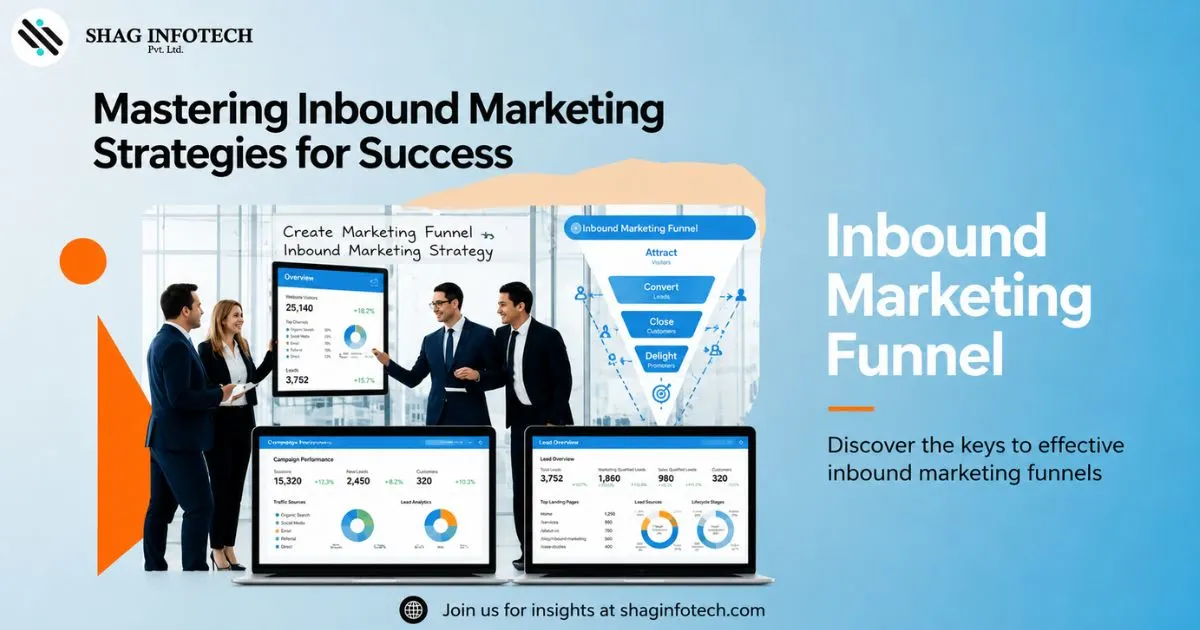
Inbound marketing is a well-structured approach that involves drawing people in, nurturing them, converting leads, and gaining customer loyalty. Each step is geared towards providing the appropriate information to customers.
Step 1: Attract
Organizations develop informative blogs, videos, guides, and other materials that will help answer customer queries. This ensures that visitors are lured into your website while looking for solutions.
Step 2: Engage
After visiting your website, interactions will be encouraged via useful content, newsletters, downloadable information, and individualized communications.
Step 3: Convert
Optimizing the landing pages with a good call-to-action encourages visitors to ask for a consultation, download information, and communicate with you.
Step 4: Delight
The journey does not stop once there is a purchase is made. The businesses continue helping out the customers through education, good communication, and an exceptional customer experience to create more business in the future.
Understanding the Inbound Marketing Funnel
The Inbound Marketing Funnel explains how potential customers move from discovering your business to becoming loyal customers. Every stage requires different content and marketing activities.
| Funnel Stage | Customer Goal | Recommended Content |
| Awareness | Learn about a problem | Blogs, Videos, Educational Articles |
| Consideration | Compare solutions | Case Studies, eBooks, Webinars |
| Decision | Choose a provider | Testimonials, Pricing Pages, Free Consultation |
| Loyalty | Stay engaged | Email Updates, Customer Resources, Support Content |
Creating content for every stage ensures customers receive useful information throughout their buying journey.
Essential Components of a Successful Strategy
Every effective inbound approach entails various types of marketing efforts that interact in order to lure, engage, and convert customers.
Audience Research
The knowledge about the problems and behavior of the customers helps the organizations develop solutions rather than make presumptions.
Valuable Content
Writing quality blog posts, videos, articles, and industry-related information will help keep your audience informed and make your company an authority on the subject.
Search Optimization
A good SEO Content Strategy makes sure that your content is aligned with user intent, keyword optimization, and SEO best practices.
Consistent Publishing
Content marketing will help businesses to establish themselves, increase organic traffic, and remain present for their audience at all times.
Lead Conversion
Optimized landing pages will make visitors perform some kind of action, such as making a request for consultation or downloading helpful materials.
Inbound Marketing vs Outbound Marketing
Both marketing approaches aim to generate customers, but they use completely different methods. Understanding these differences helps businesses choose the right strategy for their goals.
| Feature | Inbound Marketing | Outbound marketing |
| Customer Approach | Attracts interested prospects | Reaches broad audiences |
| Communication Style | Permission-based | Interruptive |
| Cost Efficiency | Better long-term ROI | Often requires higher budgets |
| Customer Trust | Built through valuable content | Built through repeated promotion |
| Long-Term Value | Sustainable growth | Mostly short-term visibility |
Many successful businesses combine both approaches. However, inbound marketing usually provides stronger long-term results because it focuses on building trust before selling.
EEAT: Building Trust Through Inbound Marketing
Inbound marketing needs to be created around experience, expertise, authority, and trustworthiness (EEAT). Search engines and AI-powered platforms value the content that shows true expertise and gives reliable information.
Businesses can strengthen EEAT by:
- Publishing accurate, well-researched content.
- Sharing practical business insights and examples.
- Updating content regularly to maintain relevance.
- Referencing trusted industry resources where appropriate.
- Providing transparent, customer-focused recommendations instead of exaggerated claims.
Content that genuinely helps readers is more likely to earn trust, improve engagement, and perform well in both traditional search engines and AI-powered search experiences.
Expert Insight
According to our experience at Shag Infotech, companies that have consistently been producing educational content and targeting the same towards their search intent have generated much better leads than companies using just paid advertisements. It is due to the reason that answering customers’ queries via blogs, landing pages, and guides helps build early trust in the customers.
Industry Insight
As per the State of Marketing Report of HubSpot, customers have a tendency to do their research before contacting a salesperson about any product or service. Firms that spend money on educating their prospects via content, SEO, and inbound marketing attract better leads and reduce their cost per acquisition of a customer. In addition, CMI research indicates that companies with a well-documented content strategy have higher chances of marketing success and business growth.
Best Practices for an Effective Inbound Marketing Strategy
Following proven best practices helps businesses attract higher-quality leads, build stronger customer relationships, and achieve sustainable marketing success.
Follow these best practices:
- Research your audience before creating content.
- Publish valuable content consistently.
- Optimize every page for search intent and user experience.
- Measure campaign performance regularly.
- Update existing content to keep it relevant.
- Use marketing automation tools to nurture leads and improve efficiency.
- Align your marketing activities with clear business goals.
Businesses that continuously refine their strategy are more likely to achieve sustainable growth than those relying on one-time campaigns.
Common Mistakes Businesses Should Avoid
Many inbound marketing campaigns fail because businesses focus on promotion instead of solving customer problems. Avoiding these common mistakes can significantly improve marketing performance.
Some mistakes include:
- Publishing content without understanding customer intent.
- Ignoring SEO optimization.
- Creating inconsistent content schedules.
- Using weak calls to action.
- Not tracking campaign performance.
- Failing to update older content.
- Depending only on paid advertising.
Correcting these issues creates a stronger marketing foundation and improves long-term results.
Real-World Business Example
Inbound marketing can be understood through a practical case study that highlights how a sustainable business growth model is achieved.
Consider a B2B software company that faced challenges in sourcing qualified leads. Rather than spending more on advertisements, the company implemented a strategy known as the Inbound Marketing Plan,where it answered questions posed by customers via blogs, guides, and webinars.
The company made downloads available to the customers, optimized its service pages, and used lead nurturing emails. Eventually, Inbound Lead Generation became easier as the customers searched for answers prior to reaching out to the sales teams.
Trust was built, and the company was able to improve Customer Acquisition while reducing reliance on paid advertising.
Decision Checklist
Before putting your marketing plan into action, ask yourself:
- Do you clearly understand your audience?
- Are you creating content that solves real customer problems?
- Is your website optimized for search intent?
- Do your landing pages encourage conversions?
- Are you measuring important marketing KPIs?
- Do you regularly update your content?
Frequently Asked Questions
1. What is an Inbound Marketing Strategy?
It is a customer-first methodology that helps businesses attract potential customers through valuable content, educational resources, and personalized experiences instead of relying on interruptive advertising.
2. How does inbound marketing generate leads?
It will attract visitors with useful content, convert them with optimized landing pages and calls to action, and finally nurture them into becoming customers.
3. Is inbound marketing suitable for small businesses?
Yes. It helps startups and small-to-medium enterprises compete against bigger companies by bringing them qualified traffic through high-quality content and SEO, instead of just using their large budgets for ads.
4. How long does inbound marketing take to produce results?
Most businesses begin seeing measurable improvements within three to six months, although results depend on competition, content quality, and consistency.
5. Can inbound marketing work with paid advertising?
Yes. The integration of inbound marketing and paid marketing is the right blend of strategies that yields short-term visibility and long-term growth.
6. Which industries benefit most from inbound marketing?
Inbound marketing can work great for SaaS, healthcare, education, manufacturing, professional services, finance, real estate, eCommerce, and B2B businesses.
Conclusion
The best way to go for an inbound marketing strategy is not only about marketing, but rather a business strategy aimed at gaining quality customers through trust-building and relationship development. With a strong focus on content, educating the customer, increasing visibility through search engines, and optimizing efforts, businesses will be able to achieve sustainable growth without depending on paid marketing methods.
Whether you are just getting started or refining your existing marketing efforts, success comes from understanding your customers, providing valuable content, and measuring what works.
Shag Infotech is here to assist businesses in developing their own unique inbound marketing strategies that use SEO, content marketing, lead generation, and performance optimization to produce business growth.