


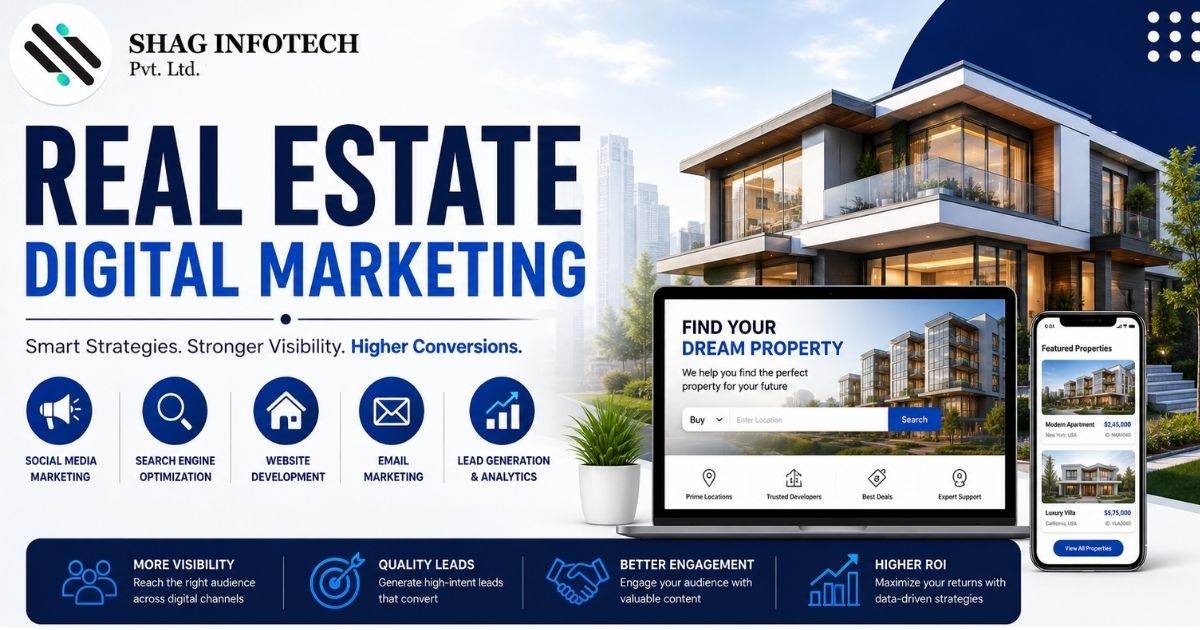
Real estate buyers now spend significant time online before contacting an agent, builder, or developer. They search for properties, compare locations, check prices, watch property videos, and read reviews before making decisions. This makes a strong online presence essential for businesses that want consistent leads.
Real Estate Digital Marketing combines search optimization, social media, paid advertising, content, and lead-generation techniques to connect property businesses with potential buyers at different stages of the buying journey.
Whether you are a realtor, property developer, builder, or real estate agency, the right strategy can help you attract relevant audiences instead of depending only on traditional advertising.
Key Takeaways
- Use SEO to make property pages easier to discover.
- Create location-focused content for potential buyers.
- Use social media to showcase properties visually.
- Run targeted paid campaigns for faster lead generation.
- Use high-quality images, videos, and virtual tours.
- Build landing pages around specific properties or projects.
- Track leads and campaign performance regularly.
- Focus on qualified leads rather than traffic alone.
Table of Contents
- What Is Real Estate Digital Marketing?
- Why Digital Marketing Matters for Real Estate
- 10 Proven Digital Marketing Strategies for Real Estate
- How to Build an Effective Real Estate Marketing Strategy
- Common Mistakes to Avoid
- Practical Example
- FAQs
- Conclusion
What Is Real Estate Digital Marketing?
Real estate digital marketing refers to using online channels to promote properties, attract potential buyers, generate leads, and build trust with prospects. It can include search engines, social media, websites, email campaigns, online advertising, and content marketing.
Unlike traditional property promotion, digital marketing allows businesses to understand how people interact with their campaigns. For example, a developer can identify which property page receives the most visits and which advertising campaign generates qualified enquiries.
This data can then be used to improve future campaigns.
Why Digital Marketing Matters for Real Estate
Real estate purchases usually involve extensive research. Buyers may compare multiple properties, neighbourhoods, developers, amenities, prices, and financing options before contacting a business.
A well-planned digital presence helps businesses remain visible during this research process.
Effective Digital Marketing for Real Estate can help with:
- Building brand awareness
- Increasing website traffic
- Generating property enquiries
- Promoting new projects
- Reaching location-specific audiences
- Improving communication with prospects
- Supporting long-term customer relationships
The key is to combine several channels rather than depending entirely on one platform.
10 Proven Real Estate Digital Marketing Strategies
1. Build a Strong Real Estate SEO Strategy
Real Estate SEO helps property businesses improve their visibility when people search for properties, locations, services, or real estate information online.
A strong SEO strategy should cover both property-specific searches and informational queries.
For example, a real estate website could target searches related to:
- Apartments for sale in a specific location
- Luxury homes in a city
- Commercial properties for lease
- Upcoming residential projects
- Property investment information
- Local neighbourhood guides
Each important property should have a useful, dedicated page with accurate information, clear images, location details, amenities, and contact options.
2. Use Real Estate Social Media Marketing
Real Estate Social Media Marketing allows businesses to present properties visually while building relationships with potential buyers.
Platforms such as Instagram, Facebook, YouTube, and LinkedIn can support different content formats and audiences.
Property businesses can publish:
- Property walkthroughs
- Short-form videos
- Construction updates
- Before-and-after content
- Local area guides
- Customer testimonials
- Project amenities
- Frequently asked questions
Consistency matters more than posting excessively. Content should provide useful information instead of turning every post into a sales pitch.
3. Focus on Real Estate Lead Generation
Real Estate Lead Generation focuses on turning online visitors and prospects into enquiries that sales teams can follow up with.
A lead-generation campaign can use dedicated landing pages, enquiry forms, calls, WhatsApp communication, downloadable brochures, or property consultation requests.
To improve lead quality, forms can ask relevant questions such as:
- Preferred location
- Property type
- Approximate budget
- Buying timeline
- Preferred number of bedrooms
This helps sales teams understand prospects before making contact.
4. Create Location-Based Property Content
Property decisions are closely connected to location. Buyers want to understand schools, transportation, shopping areas, infrastructure, lifestyle, and future development.
Creating location-based content can therefore attract people earlier in their research journey.
Examples include:
- “Best Residential Areas for Families in Dubai”
- “Things to Consider Before Buying Property in Jaipur”
- “Upcoming Infrastructure Projects Near [Location]”
- “Apartment Buying Guide for First-Time Buyers”
This type of Content Marketing can attract informational searches and introduce your brand before someone is ready to enquire.
5. Run Google Ads for Real Estate
Google Ads for Real Estate can help businesses reach people who are actively searching for property-related services or listings.
Paid search campaigns can target relevant terms based on location, property type, and user intent.
For example, a campaign for luxury apartments could focus on searches related to luxury properties in the target area.
However, successful advertising requires more than simply increasing the budget. Businesses should monitor:
- Cost per lead
- Conversion rate
- Search terms
- Landing-page performance
- Lead quality
- Return on advertising spend
Poorly targeted campaigns can generate clicks without producing valuable enquiries.
6. Invest in High-Quality Property Content
Property buyers want to understand what a property looks and feels like before arranging a visit.
High-quality photographs, videos, floor plans, virtual tours, and informative descriptions can reduce uncertainty.
A strong property presentation should clearly show:
- Property layout
- Room sizes where available
- Key features
- Amenities
- Location advantages
- Exterior and interior views
- Important specifications
Good visual content can also be reused across websites, social platforms, email campaigns, and advertising.
7. Create Conversion-Focused Landing Pages
A property landing page should make it easy for visitors to understand the offer and take the next step.
Instead of sending every advertisement to the homepage, businesses can create dedicated pages for individual projects, locations, or property types.
A useful landing page may include:
- Clear property headline
- High-quality images
- Main features
- Pricing information where appropriate
- Location details
- Floor plans
- FAQs
- Enquiry form
- Call or consultation option
The page should have one clear objective rather than overwhelming visitors with unrelated information.
8. Use Email Marketing to Nurture Leads
Not every property enquiry converts immediately. Some buyers may need weeks or months before making a decision.
Email marketing can help businesses maintain communication with these prospects.
Useful email content may include:
- New property listings
- Price updates
- Market insights
- Project announcements
- Property guides
- Open-house invitations
- Relevant investment information
The content should be useful and appropriately targeted rather than sending the same message to every contact.
9. Build a Strong Online Reputation
Trust is particularly important when people are considering a major financial purchase.
Real estate businesses should actively manage their online reputation through accurate business information, customer reviews, testimonials, and transparent communication.
Encourage genuine customers to share their experiences and respond professionally to feedback.
An established reputation can support other marketing channels because potential buyers often research a company before submitting an enquiry.
10. Work With a Specialized Real Estate Marketing Agency
A specialized Real Estate Marketing Agency can help businesses combine SEO, paid advertising, social media, content, analytics, and conversion optimization into one strategy.
This can be useful for developers and agencies managing multiple projects or locations.
When comparing providers, look at:
- Relevant industry experience
- Reporting process
- Lead-quality tracking
- SEO approach
- Paid advertising expertise
- Content capabilities
- Conversion strategy
- Communication process
The best agency is not necessarily the one promising the largest number of leads. The focus should be on relevant leads and measurable business outcomes.
How to Build an Effective Real Estate Digital Marketing Strategy
A successful strategy should begin with the business objective rather than selecting random marketing channels.
Step 1: Define Your Target Audience
Identify whether you are targeting first-time buyers, investors, luxury buyers, renters, commercial clients, or another specific group.
Step 2: Research Search Intent
Understand what your audience searches for before and after discovering a property.
Step 3: Select the Right Channels
Choose SEO, social media, paid advertising, email, content, or other channels based on your audience and goals.
Step 4: Create Useful Content
Develop property pages, guides, videos, location content, FAQs, and other resources that answer real buyer questions.
Step 5: Track Performance
Monitor traffic, enquiries, conversion rates, cost per lead, and lead quality.
Step 6: Improve Continuously
Use campaign data to identify what is working and adjust targeting, content, landing pages, and budgets.
How to Choose a Digital Marketing Partner
When selecting a provider, avoid choosing based only on promises of quick rankings or guaranteed leads.
Look for a partner that can explain:
- What strategy will be used
- Which audience will be targeted
- How results will be measured
- How often reports will be provided
- What happens when a campaign underperforms
For businesses comparing providers, a best digital marketing company in India should be evaluated based on relevant experience, transparent reporting, strategy, and the ability to connect marketing activity with business goals.
Common Mistakes to Avoid
Real estate businesses often lose opportunities because their marketing focuses heavily on promotion without considering the buyer journey.
1. Targeting Everyone
A broad audience can make campaigns expensive and less relevant.
2. Using Low-Quality Property Images
Poor visuals can reduce confidence and make properties harder to evaluate.
3. Ignoring Local Search
Location plays a major role in property decisions, so local optimization should not be overlooked.
4. Sending Traffic to Weak Landing Pages
A successful advertisement cannot compensate for a confusing or poorly designed landing page.
5. Measuring Only Traffic
High traffic does not necessarily mean high-quality leads. Track enquiries and conversions as well.
6. Stopping Campaigns Too Early
Some strategies need time and consistent testing before meaningful patterns become clear.
Practical Example
Imagine a residential developer launching a new apartment project.
Instead of relying on one advertisement, the developer could create a dedicated project page, publish location-based SEO content, showcase the project through short videos, run targeted search advertising, and collect enquiries through a simple form.
Prospects who are not ready to buy immediately could then receive useful project updates through email.
This creates a connected journey from discovery to enquiry rather than treating every marketing channel separately.
FAQs
1. What is the most effective digital marketing strategy for real estate?
There is no single strategy that works for every business. SEO, social media, paid advertising, content, and lead-generation campaigns can work together depending on the target audience, location, property type, and marketing goals.
2. How does SEO help real estate businesses?
SEO helps property websites appear for relevant searches. Real Estate Digital Marketing becomes more effective when optimized property pages and useful location-based content attract people with relevant search intent.
3. Is social media useful for real estate marketing?
Yes. Social platforms are particularly useful for showcasing properties through videos, images, walkthroughs, testimonials, and educational content.
4. How can real estate companies generate better leads?
Businesses can improve lead quality by targeting specific audiences, creating dedicated landing pages, using relevant advertising keywords, and asking qualifying questions in enquiry forms.
5. Should real estate businesses use Google Ads?
Google Ads can be useful when businesses want to reach people actively searching for property-related products or services. Campaign performance should be measured using lead quality and conversions, not clicks alone.
6. How long does real estate SEO take?
SEO timelines vary depending on competition, website quality, location, content, authority, and technical factors. Unlike paid advertising, SEO generally requires consistent work before substantial organic growth is visible.
7. What content should real estate companies publish?
Useful content includes property guides, location information, market insights, project updates, FAQs, videos, property walkthroughs, and buyer education.
Conclusion
Real Estate Digital Marketing gives property businesses multiple ways to reach potential buyers, build trust, and generate relevant enquiries. The strongest approach combines SEO, social media, content, paid advertising, landing pages, reputation management, and consistent performance tracking.
Rather than choosing every available channel, focus on the platforms and strategies that match your audience and business objectives. A data-driven approach can help you understand what attracts prospects and what turns them into genuine opportunities.
For businesses looking to build a structured online growth strategy, shaginfotech can help develop and manage digital marketing campaigns focused on visibility, qualified leads, and sustainable growth.