

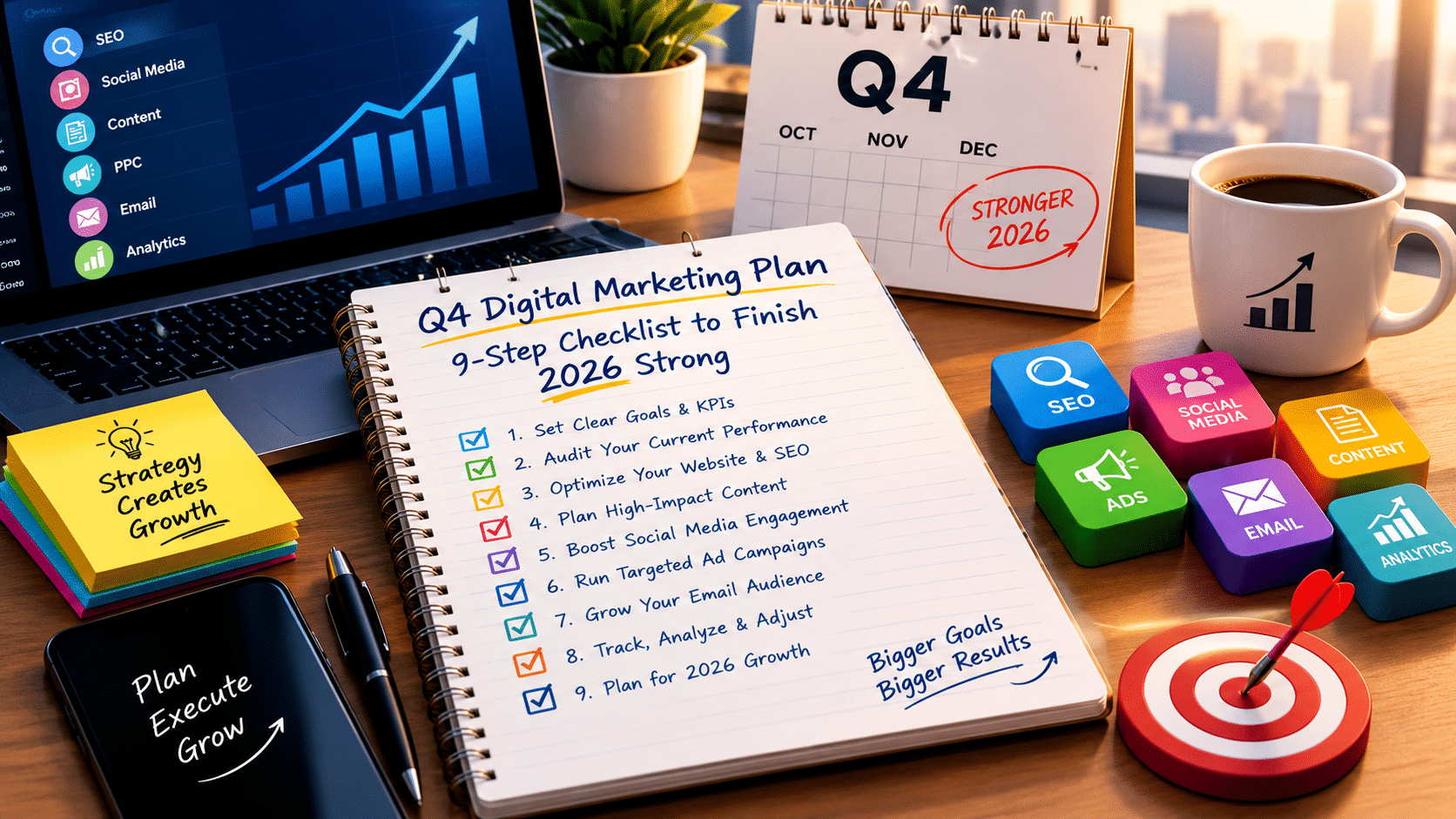
The final quarter can determine whether a business finishes the year ahead of its targets or enters January trying to recover lost ground. A practical q4 digital marketing strategy helps businesses focus their budget, content, campaigns and customer experience around the opportunities that matter most in October, November and December.
Q4 is also changing as customers increasingly use AI tools and search platforms to discover products, compare options and make purchase decisions. Google’s 2026 holiday guidance highlights the growing importance of conversational discovery, accurate product information, strong measurement and timely campaigns.
For startups, SMEs, ecommerce businesses and established companies, the goal should not be to launch everything at once. Instead, use a structured nine-step process to identify priorities, prepare campaigns, improve conversion paths and measure what actually contributes to revenue.
Key Takeaways
- Audit your existing performance before increasing Q4 spending.
- Set specific revenue, lead and conversion targets.
- Prioritise high-intent audiences and profitable channels.
- Prepare landing pages, product pages and websites for higher demand.
- Build campaigns around relevant seasonal and commercial moments.
- Combine SEO, paid advertising, email, social media and content.
- Track conversions and attribution consistently across channels.
- Keep campaigns flexible enough to respond to real-time performance.
- Use Q4 data to inform your marketing decisions for 2027.
Why Q4 Requires a Different Marketing Approach
Q4 is different because consumer demand, advertising competition and seasonal buying behaviour can change quickly. A strong q4 digital marketing strategy connects business objectives with customer intent instead of treating October, November and December as three ordinary months.
For ecommerce companies, Q4 may include major promotional periods such as Black Friday, Cyber Monday, Christmas and New Year campaigns. For B2B companies, the quarter can focus more heavily on year-end budgets, pipeline generation and preparing prospects for the next financial year.
Google notes that seasonal advertising demand can begin increasing before the biggest shopping periods, making early preparation important.
| Business type | Q4 priority | Useful channels |
| Ecommerce | Sales and repeat purchases | Search, Shopping, email, social |
| B2B | Leads and pipeline | SEO, LinkedIn, search, email |
| Local business | Bookings and enquiries | Local SEO, search, social |
| Startup | Awareness and acquisition | Content, paid social, SEO |
| SaaS | Trials and subscriptions | Search, content, email, retargeting |
Step 1: Audit Your Current Digital Marketing Performance
Before changing your campaigns, understand what already works. Review the previous quarter and year-to-date data to identify your strongest traffic sources, conversion paths, campaigns, landing pages and audience segments.
Look at:
- Organic traffic and rankings
- Paid advertising performance
- Conversion rates
- Cost per lead or acquisition
- Email open and click rates
- Social engagement
- Revenue by channel
- Returning versus new customers
- Top-performing landing pages
- Underperforming campaigns
Do not evaluate channels only by traffic. A channel generating fewer visitors may still be more valuable if those visitors convert at a higher rate.
Google Analytics supports cross-channel reporting that helps businesses understand which channels and campaigns receive credit for important customer actions.
Q4 Digital Marketing Strategy Audit Checklist
Ask:
- Which channels generated the most qualified conversions?
- Which campaigns consumed budget without producing sufficient results?
- Which landing pages need improvement?
- Which products or services have the highest margins?
- Which customer segments are most valuable?
- What did last year’s Q4 data reveal?
This audit becomes the foundation for the rest of your plan.
Step 2: Set Q4 Goals and KPIs
Your Q4 plan should have measurable business goals rather than vague objectives such as “increase visibility.” Define what success means and connect each marketing activity to a measurable outcome.
Common Q4 KPIs include:
- Revenue
- Qualified leads
- Conversion rate
- Customer acquisition cost
- Return on ad spend
- Average order value
- Customer lifetime value
- Organic traffic
- Email revenue
- Marketing-qualified leads
A useful framework is:
Business goal → Marketing objective → Campaign → KPI → Target
For example:
Goal: Increase Q4 ecommerce revenue
Objective: Generate more high-intent traffic
Campaign: Search and Shopping campaigns
KPI: Conversion value and ROAS
Google Analytics allows businesses to define important actions as key events and use those measurements for campaign optimisation and reporting.
Step 3: Define Your Highest-Value Audiences
Q4 becomes easier to manage when you know exactly who you are trying to reach. Instead of targeting everyone, divide your audience according to intent, customer value and purchase stage.
Useful segments include:
New Prospects
These users need education, proof and a clear reason to consider your brand.
Returning Customers
Existing customers may respond well to personalised offers, product recommendations and loyalty incentives.
High-Intent Visitors
People who viewed pricing, product or service pages may need stronger calls to action or remarketing.
Abandoned Visitors
Users who added products to carts, started forms or visited important pages can be re-engaged through suitable remarketing campaigns.
For B2B companies, audience segmentation can also consider company size, industry, job role, location and buying stage.
The objective is not simply to create more audience groups. It is to create segments that allow you to make better decisions about messaging, budget and offers.
Step 4: Strengthen Your Website and Conversion Paths
A successful campaign cannot compensate for a poor landing page. Before Q4 traffic increases, review your website, mobile experience, forms, checkout process, page speed, navigation and calls to action. Professional web design services can help improve the overall user experience and conversion path.
Your website should make it easy for visitors to answer four questions:
- What do you offer?
- Why should they trust you?
- Why should they choose you now?
- What should they do next?
For ecommerce websites, check product availability, pricing, delivery information, returns and payment options. Google specifically recommends keeping inventory, pricing and shipping information updated as AI increasingly influences shopping discovery.
For service businesses, review:
- Service pages
- Contact forms
- Booking processes
- Testimonials
- Case studies
- FAQs
- Trust signals
- Mobile responsiveness
Step 5: Build Your Q4 Content and SEO Calendar
Your content plan should support the customer journey before, during and after major seasonal moments. Start with topics that answer customer questions and gradually connect them to your products or services.
Your Q4 marketing plan can include:
- Buying guides
- Comparison pages
- Product-focused blogs
- Seasonal landing pages
- FAQs
- Case studies
- Customer stories
- Video content
- Social posts
- Email newsletters
- Promotional content
For SEO, prioritise pages that already have some visibility or authority before creating dozens of completely new pages.
Build Content Around Search Intent
| Search intent | Content type | Example |
| Informational | Blog/guide | Q4 marketing planning tips |
| Commercial | Comparison | Best marketing services for SMEs |
| Transactional | Landing page | Holiday marketing services |
| Navigational | Service page | Digital marketing agency |
Content should also be structured for AI-powered discovery. Use direct answers, descriptive headings, clear facts, relevant examples and well-organised information that can be understood without relying on surrounding context.
Step 6: Plan Paid Advertising and Retargeting
Paid campaigns can help capture demand when competition increases, but increasing spend without a clear strategy can quickly reduce profitability.
Separate your budget according to objectives:
Prospecting: Reach new potential customers.
Consideration: Bring interested users back with useful information or proof.
Conversion: Target users showing strong purchase or enquiry intent.
Retention: Encourage existing customers to purchase again.
Review your campaign structure before increasing budgets. Make sure tracking is working, conversion events are correctly configured and landing pages match the advertisement.
Google’s current holiday guidance also recommends thinking beyond last-click behaviour because customers may interact with multiple channels before converting.
Paid Campaign Optimisation Checklist
- Review search terms.
- Remove irrelevant traffic.
- Refresh outdated creative.
- Test landing pages.
- Adjust audience targeting.
- Monitor acquisition costs.
- Track conversion value.
- Compare performance by device.
- Review campaign frequency.
- Reallocate budget toward proven performers.
Do not automatically increase spending on every campaign that produces conversions. Consider profitability, customer value and the quality of those conversions.
Step 7: Launch Relevant Holiday Campaigns
Holiday marketing works best when the campaign is connected to a real customer need rather than simply adding festive graphics to an existing promotion.
Start by mapping important dates to your audience. Depending on your market, this could include Diwali, Halloween, Thanksgiving, Black Friday, Cyber Monday, Christmas, New Year or industry-specific buying periods.
For Indian audiences, festive demand can start earlier than many businesses expect. Google reported that search interest for “Diwali sales” began increasing as early as August in 2026, showing why preparation should begin before the major promotional period.
Build Campaigns Around Customer Needs
Instead of:
“Our biggest sale is here!”
Try a message focused on a clear benefit:
“Complete your year-end shopping with exclusive bundles and faster delivery.”
Your holiday campaigns can include:
- Limited-time offers
- Bundles
- Gift guides
- Seasonal packages
- Loyalty offers
- Referral promotions
- Email-exclusive deals
- Early-access campaigns
- Retargeting sequences
Make sure promotional claims, deadlines and availability are accurate. Urgency should be genuine rather than manufactured.
Step 8: Measure, Test and Optimise Weekly
Q4 should not be managed through a single end-of-month report. Monitor performance frequently enough to identify problems while there is still time to act.
A strong digital strategy should establish a weekly optimisation cycle:
Measure → Analyse → Identify → Test → Optimise → Repeat
Track both leading and lagging indicators.
Leading indicators include:
- Click-through rate
- Engagement
- Landing-page visits
- Add-to-cart actions
- Form starts
Lagging indicators include:
- Revenue
- Qualified leads
- Sales
- Customer acquisition cost
- Return on ad spend
Google Analytics has continued adding cross-channel measurement and budgeting capabilities in 2026, reinforcing the importance of evaluating performance across channels rather than viewing each campaign in isolation.
What to Test
Test one meaningful variable at a time where possible:
- Headline
- CTA
- Offer
- Creative
- Landing page
- Audience
- Email subject line
- Ad format
Document the result. A failed test can still produce useful information if it improves the next decision.
Step 9: Turn Q4 Data Into a Q1 Growth Plan
Q4 should not end when the calendar changes. The data collected during the quarter can help shape your first-quarter priorities.
Analyse:
- Best-performing products
- Most profitable audiences
- Highest-converting channels
- Strongest content
- Customer acquisition costs
- Repeat purchase behaviour
- Promotional performance
- Seasonal demand patterns
Google has highlighted the value of turning holiday shopping data into longer-term customer insights instead of treating seasonal revenue as the only outcome.
Create a simple Q1 action list:
| Q4 finding | Q1 action |
| SEO generated qualified leads | Expand successful topic clusters |
| Paid search produced strong ROAS | Test additional high-intent terms |
| Email drove repeat sales | Improve segmentation |
| One audience converted better | Increase relevant targeting |
| A landing page underperformed | Redesign and retest |
This turns your Q4 campaign into a learning system rather than a one-time promotion.
Best Practices for a Strong Q4 Plan
A practical Q4 marketing strategy should balance preparation with flexibility. The strongest plans establish clear priorities before the quarter begins but leave room to change budgets, messaging and content when performance data shows a better opportunity.
Follow these practices:
- Start preparation before peak demand.
- Focus on profitable customer segments.
- Keep website information accurate.
- Use consistent campaign tracking.
- Align ads with landing-page messaging.
- Create mobile-first experiences.
- Refresh creative before performance declines.
- Monitor campaigns regularly.
- Use first-party customer data responsibly.
- Keep promotional terms clear.
- Connect Q4 results with Q1 planning.
Common Q4 Marketing Mistakes
Avoiding mistakes can be as valuable as launching new campaigns.
1. Starting Too Late
Waiting until a major shopping event begins leaves little time to build awareness, test creative or fix technical problems.
2. Discounting Everything
Constant discounts can reduce margins and train customers to wait for promotions.
3. Ignoring Existing Customers
Acquiring new customers is only part of the opportunity. Existing customers can be valuable for repeat purchases and referrals.
4. Measuring Vanity Metrics
High impressions or social engagement do not necessarily mean business growth. Connect reporting to meaningful business outcomes.
5. Sending Traffic to Generic Pages
A seasonal advertisement should usually lead to a relevant landing page rather than an unrelated homepage.
6. Treating Every Channel Equally
Your best channel may differ from another company’s best channel. Allocate resources according to performance and business objectives.
FAQs
1. What is a q4 digital marketing strategy?
A q4 digital marketing strategy is a focused plan for using SEO, paid advertising, content, email, social media and other channels to achieve business goals during the fourth quarter.
2. When should businesses start planning Q4 marketing?
Ideally, preparation should begin several weeks or months before the busiest promotional period. This gives teams time to audit performance, prepare content, test campaigns and resolve website issues.
3. Which channels should be included in a Q4 marketing plan?
The right mix depends on your audience and goals. Common channels include SEO, paid search, paid social, email marketing, content marketing, social media and remarketing.
4. How can businesses measure Q4 campaign performance?
Track business-focused KPIs such as revenue, qualified leads, conversion rate, customer acquisition cost, return on ad spend and customer lifetime value. GA4 can help connect key events with channel and campaign performance.
5. Should small businesses increase their Q4 advertising budget?
Not automatically. Small businesses should first identify campaigns that produce profitable results and then scale spending carefully while monitoring acquisition costs and conversion quality.
6. How does AI affect Q4 digital marketing?
AI is increasingly influencing how customers discover, compare and evaluate products and services. Businesses should provide accurate information, strong content, clear product data and useful answers that can be understood across traditional and AI-powered search experiences.
7. What should businesses do after Q4 ends?
Analyse customer, campaign and revenue data, document successful tests, identify inefficient spending and convert those findings into Q1 priorities.
8. Can a Q4 strategy help with SEO?
Yes. Q4 can reveal valuable search trends, customer questions and high-performing content topics that can inform your ongoing SEO and content strategy.
Conclusion:
A successful q4 digital marketing strategy helps businesses finish 2026 with better visibility, stronger conversions and clear insights for the year ahead. By reviewing performance, refining campaigns, improving your website and targeting the right audiences, you can make every marketing investment more effective. Shag Infotech supports businesses with services including SEO, AEO, GEO, AI SEO, web design and digital marketing solutions. Its team can help build a data-driven strategy that connects search, content, website performance and paid campaigns to support sustainable business growth.