

Companies spend hours responding to customer inquiries, maintaining data, generating reports and doing other mundane work. This is important, but it leaves staff little time for strategising, problem-solving, and customer relations.
AI agents are able to undertake several of these repetitive tasks. They can comprehend directions, gather information, use linked software and accomplish tasks within specified limits. Unlike conventional chatbots, they can also perform certain tasks that are sanctioned by them.
Through AI agent development services, companies have an opportunity to automate routine processes and enable their workers to concentrate on something that is more worthwhile. Below is a list of ten ways AI agents can benefit businesses.
What Are AI Agents?
AI agents are programs that utilise AI technology to understand objectives and process information or perform tasks by means of interconnected devices. They can obtain information, update data, generate reports and coordinate a series of actions.
For instance, the chatbot could demonstrate how to track the order. The AI agent will check the order management system, obtain the data about delivery and generate an update report for the client.
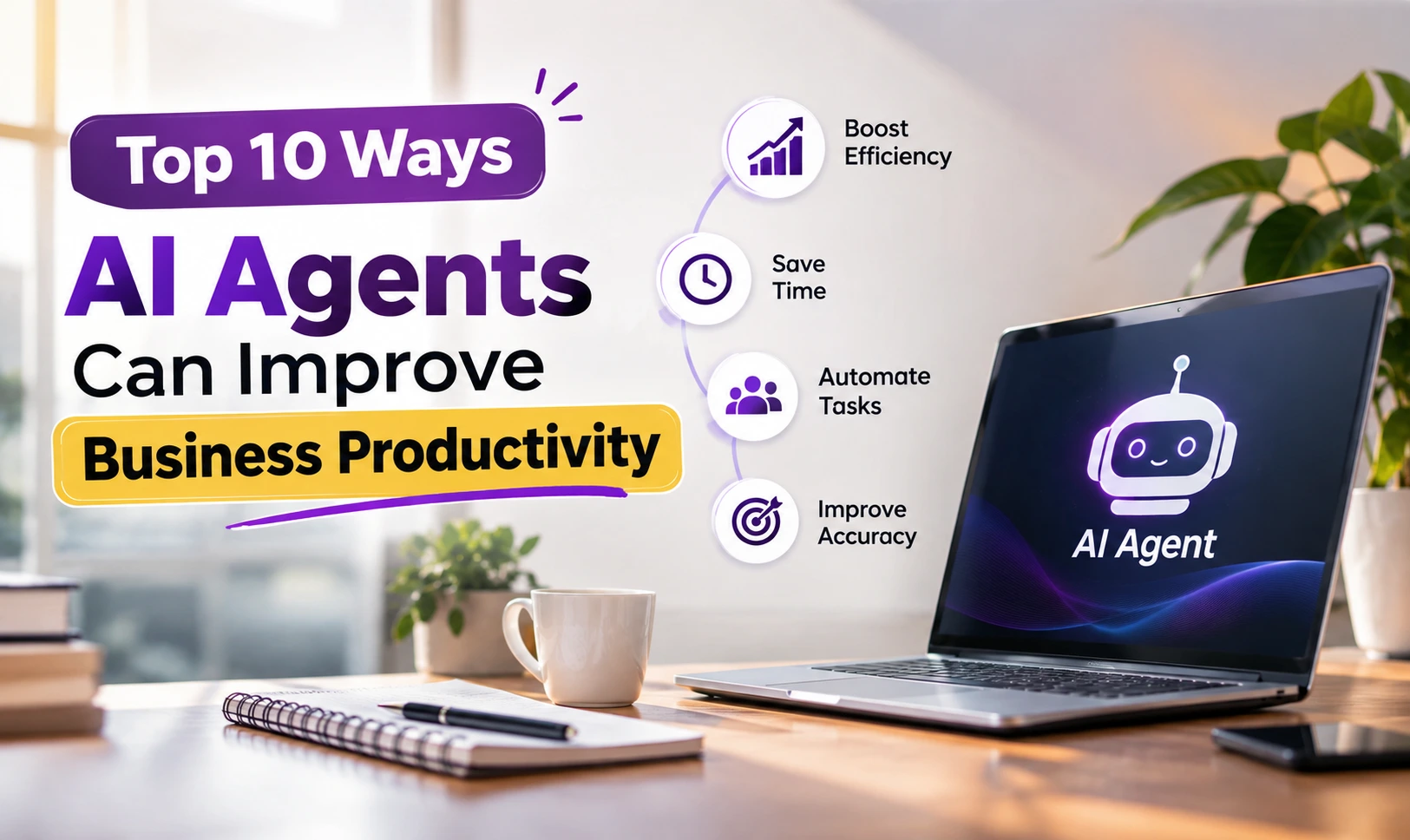
Top 10 Ways AI Agents Improve Business Productivity
1. Customer Service and Tier-1 Resolution
These customer support groups get repetitive queries regarding order status, delivery dates, return requests, account issues, and product details. Manually responding to all of them might delay the process.
AI bots have the ability to fetch data from authorised systems and respond to common queries. They are capable of confirming delivery status, answering common queries, creating support tickets, and providing product details.
If there is something that needs human intervention, the call can be transferred along with the complete history of the conversation. This prevents duplication of effort on the part of customer service agents.
2. Sales Lead Qualification and Triage
The sales department may have to evaluate inquiries, look into prospects and keep their details updated. The AI agent may be used for this pre-research and to help the representatives prioritise the most valuable leads.
The agent may be able to check website forms, compare leads to preset criteria, and rate leads. The agent can also schedule meetings and write follow-up emails.
Through AI agent development services, companies can integrate their processes with CRM systems, emails, and calendars. The sales team will be able to use this precious time to meet with potential customers rather than sorting out inquiries.
3. Finance and Accounting Automation
The finance department controls invoicing, expense reports, payment records, and reconciliations. Quite often, all of those processes include comparing identical data from different forms.
The AI Finance Assistant will be able to read data from invoices, match them against purchase orders and detect inconsistencies, as well as classify expenses and generate reconciliations.
Common applications include:
- Invoice extraction and matching
- Expense categorisation
- Payment status tracking
- Reconciliation support
- Financial report preparation
For instance, when an invoice is incompatible with a purchase order that is approved, the agent may submit it for approval rather than going ahead with it automatically. Sensitive payments should always be under the control of employees.
4. HR and Employee Support
FAQs on leave policies, benefits, onboarding documents, and company policies are constantly being answered by the HR department. The agent can assist in finding out the approved information before an HR representative even arrives.
The agent can take care of guiding the recruits about submitting their documents, provide policy information, remind them about ongoing activities and even route specialised queries to the right HR individual.
The AI agent development company can tie these systems to the approved HR documents and employee portals. Access restrictions are necessary for managing payroll data and other confidential information about employees.
5. IT Operations and Technical Support
The IT department gets requests related to password resets, software access, device-related issues, and system alerts. Most of these issues have a standard solution procedure.
The IT support personnel can gather information about the problem, perform an internal search for solutions, and provide employees with basic problem solutions. This system can also be used to classify the support requests and transfer them to technical personnel.
Autonomous AI agents can observe certain system warnings and perform pre-planned actions to solve them. Nevertheless, actions that have to do with security, privileges, and infrastructure must be cleared by authorised employees.
6. Marketing Content and Campaign Operations
Marketing departments schedule emails, social media updates, editorial calendars and performance reports. An AI assistant can assist in organising all this information and decrease administrative burdens.
A marketing assistant can draft emails, recommend social media updates and compile a report on campaign performance. It will also be able to report on any fluctuations in clicks, conversion rates and ad spending.
Use cases include content scheduling, campaign reporting, audience research and coordination of leads’ follow-ups.
The need for human oversight persists for brand tone of voice, factual correctness and advertisements. AI agent development services may help in such processes by integrating with approved marketing platforms.
7. Data Analysis and Business Intelligence Reporting
Business information usually resides in spreadsheets, CRM systems, ERP systems and databases. The information collection process becomes time-consuming during manual data gathering.
AI agents will be able to extract authorised data, find trends and make summaries in response to natural language queries.
For instance, the sales manager may request a report that compares the revenue per month across various geographical regions. The agent is capable of collecting the figures and preparing a report.
Companies can build AI agents for business reporting processes, which will help in creating reports, performance analysis, and detecting anomalies. It is still important to verify significant numbers from the sources.
8. Supply Chain and Inventory Management
Coordinating activities between the suppliers, stock levels, orders, and delivery schedules is done by supply chain groups. There could be consequences for delays and wrong estimates on cost and customer satisfaction.
AI could monitor the inventory level and check for any updates from the supplier to detect products that require replenishment. It could then come up with purchase suggestions depending on stock levels.
For instance, in the case where a component becomes scarce in a warehouse, the agent is capable of informing the procurement team about the same and even giving them a summary of information about suppliers.
9. Meeting Preparation and CRM Administration
Time is spent by employees on preparing for meetings, revisiting past discussions and making updates to their CRM. An AI agent would help to cut down on this paperwork.
Prior to the meeting, the agent is capable of gathering approved data from the CRM system, e-mail, and internal documentation. This allows the creation of a briefing that has the customer’s history, to-do items, and other discussion points.
Following the meeting, the system is capable of organising notes, highlighting action points, and generating CRM updates for review by the employees. The employees must authenticate the summaries prior to sharing or altering the customers’ details.
10. Enterprise Workflow Orchestration
Most business processes usually need input from more than one department or software platform. The request for a project may need the gathering of documents, creation of tasks and approvals by various departments.
Such agents will be able to undertake the process using the connected enterprise applications. One agent will be responsible for the interpretation of the request and allocation of tasks.
Companies may build AI agents for business process which gathers reference documents, writes project proposals, generates task tickets and proposes team members. Supervisors may examine key deliverables before the process proceeds.
How to Implement AI Agents in Your Business
Prior to engaging the AI agent development servicescompanies need to first determine repetitive processes and the improvements that they want to make.
- Identify suitable tasks: Begin with support tickets, CRM updates, invoices, or reports.
- Set measurable objectives: Determine if you want to increase speed, reduce manual effort, or improve response times.
- Prepare data and integrations: Verify data quality, software compatibility, and access permission levels.
- Establish security controls: Outline the data and functions that agents should have access to and what functions need human authorisation.
- Start with a pilot: Test one process before automating in all departments.
- Measure performance: Measure accuracy, time taken, feedback from staff members, and operational costs.
An ideal AI agent development company should assist with planning, implementation, testing, and monitoring. An ideal AI agent development organisation should also help identify system constraints and propose security measures.
What Should Businesses Consider Before Using AI Agents?
Not all activities are supposed to be automated. The company needs to take into account the impact that would be caused by mistakes and the sensitivity of data involved.
For instance, preparing a weekly report will involve basic checking for accuracy, whereas approving payment calls for stringent measures. The Autonomous AI agents must have permissions within which to operate and must have transaction logs for the same.
Frequently Asked Questions
1. What are AI agents in business?
Agents are software programs that are able to comprehend commands and perform functions using the related tools under certain limits. They help in performing tasks in sales, customer service, finance, and operations.
2. Can AI agents work with existing business software?
Yes. With different integrations, it is possible for agents to be able to access CRM, ERP, HR, accounting, and project management systems using API and connectors.
3. Are AI agents suitable for small businesses?
Yes. Small enterprises may start off with certain specific tasks such as queries from customers, lead generation, or invoice processing.
4. How do businesses measure AI agent performance?
Business organisations can monitor the time taken to complete a task, efficiency levels, effectiveness, workload of the employees, customer satisfaction levels, and operational costs.
5. Do AI agents replace employees?
The use of artificial intelligence assistants is usually meant to help employees by performing repetitive tasks. However, human judgment plays an important role in decision-making.
Conclusion
AI automation will help increase business productivity by cutting down on redundancy, integrating different software applications and increasing speed in accessing information for staff members. Through proper AI agent development services, you can achieve automation in different business processes such as customer support, sales, finance, marketing and workflow management.
Companies need to start with a proper use case, then put appropriate controls in place and evaluate their performance before scaling. If you intend to automate your business using AI,reach out to Shag Infotech for a consultation on your needs and roadmap.