

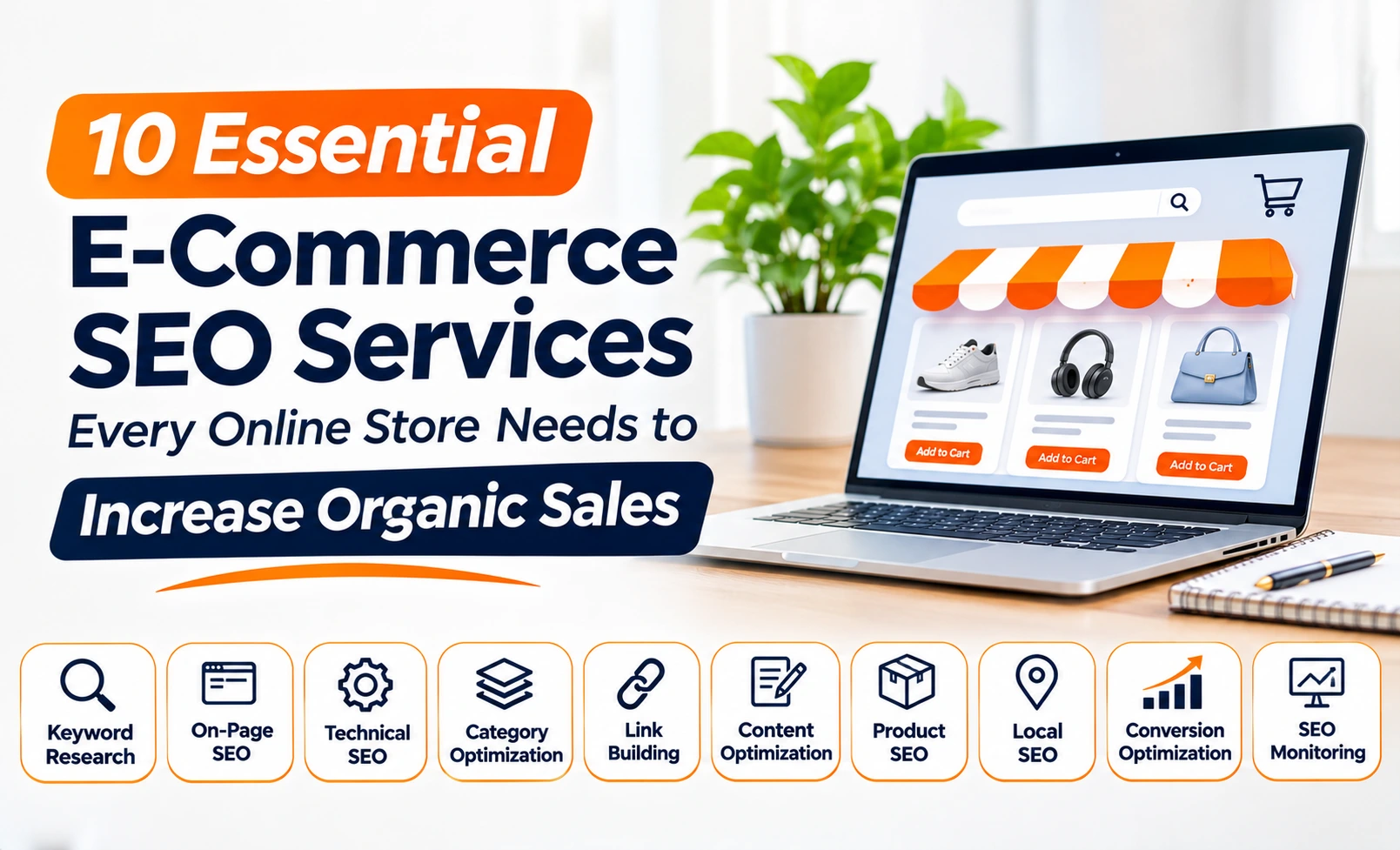
Having an online store is much more than listing products and waiting for potential buyers to approach you. Many companies based in USA and India are facing issues of no traffic, poor visibility and sales even though they have good quality products because their websites are not optimised properly in terms of search engines and customers’ needs. Here come ecommerce SEO services to rescue them. Ecommerce SEO services can help many online stores to get better visibility on Internet, get appropriate shoppers and improve the visibility of their products. Starting from keyword research and continuing with other types of ecommerce SEO services, here we discuss 10 most important ones for your online store.
What Are E-Commerce SEO Services?
E-commerce SEO means that we optimize content, product pages, as well as the whole structure of an online shop, to enhance its visibility in organic search results.
The thing is that unlike general business websites, the number of pages of an online shop can range from several dozens to several thousand product pages. They should all be properly optimized to allow search engines to understand their content and users to navigate them.
Thus, if a user searches for “buy wireless headphones online” in America or “best headphones under ₹2,000” in India, he or she expects some relevant results.
And here is where SEO comes into play.
10 Essential E-Commerce SEO Services Every Online Store Should Consider
1. E-Commerce SEO Audit
An SEO audit identifies website problems that may affect search visibility and performance.
Common issues include:
- Important product pages are not being indexed.
- Product description duplication.
- Broken internal links.
- Lack of title tags and meta descriptions.
- Slow loading speed.
- Incorrect canonical tags.
Professional audits consider these concerns through the use of software like Google Search Console and website crawlers. This assists businesses to know what should be addressed before further optimization efforts are made.
2. E-Commerce Keyword Research
Keyword research helps businesses understand what potential customers search for before purchasing products.
For example, a US fashion store may target “women’s summer dresses online”, while an Indian clothing store may focus on “cotton kurtis for women”.
A keyword strategy should include:
| Keyword type | Example | Suitable page |
| Informational | How to choose running shoes | Blog |
| Commercial | Best running shoes for beginners | Buying guide |
| Transactional | Buy running shoes online | Product or category page |
| Brand-related | Nike running shoes | Brand page |
Search for relevant keywords, analyze your competitors, and link them to relevant web pages rather than using all of them on one page.
3. Product Page SEO
Product pages directly influence how shoppers discover and evaluate individual products.
Effective product page SEO includes:
- Writing original product descriptions.
- Creating descriptive product titles.
- Adding high-quality product images.
- Including genuine customer reviews.
- Providing accurate specifications and sizes.
- Adding relevant internal links.
- Displaying updated stock and availability information.
For example, instead of using a generic title like “Office Chair”, use “Ergonomic Adjustable Office Chair with Lumbar Support”.
This gives customers more useful information and makes the page’s subject clearer to search engines.
4. Category Page SEO
Category pages enable shoppers to browse through relevant items and find the right category.
An electronics store can make different categories such as gaming laptops, business laptops and student laptops instead of listing all items in one page.
Good category page SEO includes relevant descriptions, organised product listings, helpful filters, internal links and useful FAQs.
| Element | Recommended improvement |
| Page title | Include the main category keyword |
| Description | Explain the available product range |
| Filters | Add price, size and brand options |
| Internal links | Connect relevant subcategories |
| FAQs | Answer common shopping questions |
Also manage filtered URLs carefully to avoid creating unnecessary duplicate pages.
5. Technical SEO
Technical SEO makes it easier for search engines to crawl, understand and index your online store.
Important activities include:
- XML sitemaps and robots.txt analysis.
- Link repair and indexing issues.
- Proper use of canonical tags.
- Reducing website loading time.
- Mobile optimization.
- URL duplication management.
For example, an online store with thousands of product filters may generate unnecessary URLs. Proper technical management helps search engines focus on valuable pages.
6. Website Architecture and Internal Linking
A confusing website structure can make it difficult for customers to find products.
Organise your store into a logical hierarchy:
Home → Electronics → Laptops → Gaming Laptops → Products.
Internal links should connect relevant products, categories and buying guides. Breadcrumb navigation and clear menus also improve usability.
This helps shoppers explore your website while making important pages easier for search engines to discover.
7. E-Commerce Content Marketing
It is not true that all customers are willing to buy straight away. There are some who require comparisons or guidance on purchases.
Content marketing helps businesses reach these potential customers.
For example, a furniture store could publish:
- Choosing a Sofa That Will Suit Your Living Space.
- Leather Sofa Vs Fabric Sofa: Which is Superior?
- Furniture Design Tips for Small Spaces.
Link these articles naturally to relevant products and categories. Focus on answering genuine customer questions instead of publishing content only to include keywords.
8. Product Schema Markup and Structured Data
Structured data helps search engines understand important product information.
Useful schema types includeProduct, Offer, ProductGroup and BreadcrumbList. For instance, correct Product Schema could inform about the name, price, and availability of products. Correct information might also qualify a page to have enhanced search listings.
However, structured data does not guarantee rich results or higher rankings.
9. AEO and GEO Optimisation
Customers increasingly use conversational search and AI-powered tools to research products.
Answer Engine Optimisation (AEO) focuses on making information clear and useful for answer-based search experiences.
Generative Engine Optimisation (GEO) focuses on helping generative AI systems understand and reference relevant brand information.
Businesses can improve their content by:
- Addressing typical product queries.
- Publishing original comparisons of products.
- Being accurate with product specifications.
- Consistency of information for brands.
- Authentic customer experiences.
- Clear headings and explanations.
For example, a skincare store can publish a guide explaining how to choose a moisturiser, supported by relevant product information.
10. Competitor Analysis, Link Building and Performance Tracking
Competitor analysis helps businesses identify keyword opportunities, content gaps and areas where their websites need improvement.
Relevant link building can also help establish credibility through genuine mentions and editorial links from trustworthy websites.
Track performance using Google Analytics 4 and Google Search Console.
| Metric | What it measures |
| Organic clicks | Visitors from unpaid search |
| Impressions | Search result visibility |
| CTR | Search listing click-through rate |
| Organic conversions | Actions completed by organic visitors |
| Organic revenue | Revenue attributed to organic search |
These metrics help businesses understand whether their SEO efforts are contributing to meaningful growth.
How to Choose the Right E-Commerce SEO Company?
Choosing the right ecommerce SEO company is important because different online stores have different optimisation requirements.
Before selecting a provider, consider:
- Platform experience: Does the provider understand Shopify, WooCommerce or Magento?
- Technical expertise: Can it identify crawling, indexing and website performance problems?
- Content strategy: Can it improve product descriptions and category pages?
- Transparent reporting: Does it track conversions and organic revenue?
- Business understanding: Does it understand your products, customers and target markets?
An experienced ecommerce SEO agency should provide a clear strategy based on your business objectives rather than promising guaranteed rankings.
How Shag Infotech Can Support Your E-Commerce Growth
Technical improvement management, product optimization, and other things can be difficult to manage by growing online companies.
Shag Infotech provides digital marketing and SEO services, which can be taken into consideration when you plan to improve your online business.
No matter whether your customer base is located in the USA or in India, you need to concentrate on keywords, website organization, useful product information, etc.
Explore Shag Infotech’s digital marketing solutions to learn more about its digital growth services.
USA vs India: Important SEO Considerations
Businesses targeting both markets should understand differences in customer expectations and shopping behaviour.
| Factor | USA | India |
| Currency | USD ($) | INR (₹) |
| Payments | Cards and digital wallets | UPI, cards and cash on delivery where available |
| Shipping | Delivery costs and timelines | PIN-code coverage and delivery options |
| Search behaviour | Brands, specifications and comparisons | Product categories, pricing and value |
| Mobile experience | Mobile and desktop optimisation | Strong focus on mobile usability |
Use relevant regional product data, shipping information, currency settings, and international SEO optimization while catering to customers from both countries.
Conclusion
A growth strategy for an online store is not just about selling beautiful items or placing ads. Businesses need to enhance their product discoverability, site speed, content quality, and customer experience.
These 10 tools can be a good starting point in identifying issues on a website and establishing a solid SEO foundation.
With the right ecommerce SEO services businesses can attract relevant shoppers, improve product visibility and develop a sustainable source of organic traffic.
Frequently Asked Questions
1. What services are included in e-commerce SEO?
Some of these include SEO audit, keyword analysis, product & category optimization, technical SEO, content marketing, structured data, competitor analysis and performance monitoring.
2. How can SEO increase online store sales?
The SEO helps the customers searching for products. Improved product information and navigation can help make purchase decisions as well.
3. How much do e-commerce SEO services cost?
Costs depend on website size, competition, product catalogue and the amount of optimisation required.
4. Which platforms can benefit from e-commerce SEO?
Shopify, WooCommerce, Magento, and even a custom e-commerce website will benefit from SEO.
5. How long does e-commerce SEO take to show results?
It depends on competition, website condition and optimisation efforts. SEO generally requires consistent work over several months, without guaranteed ranking timelines.
6. Should I hire an e-commerce SEO agency?
Professional help will serve useful for business organizations dealing with large inventories, technical problems, or tough competition. Select the agency that provides clear deliverables and transparent reporting.