

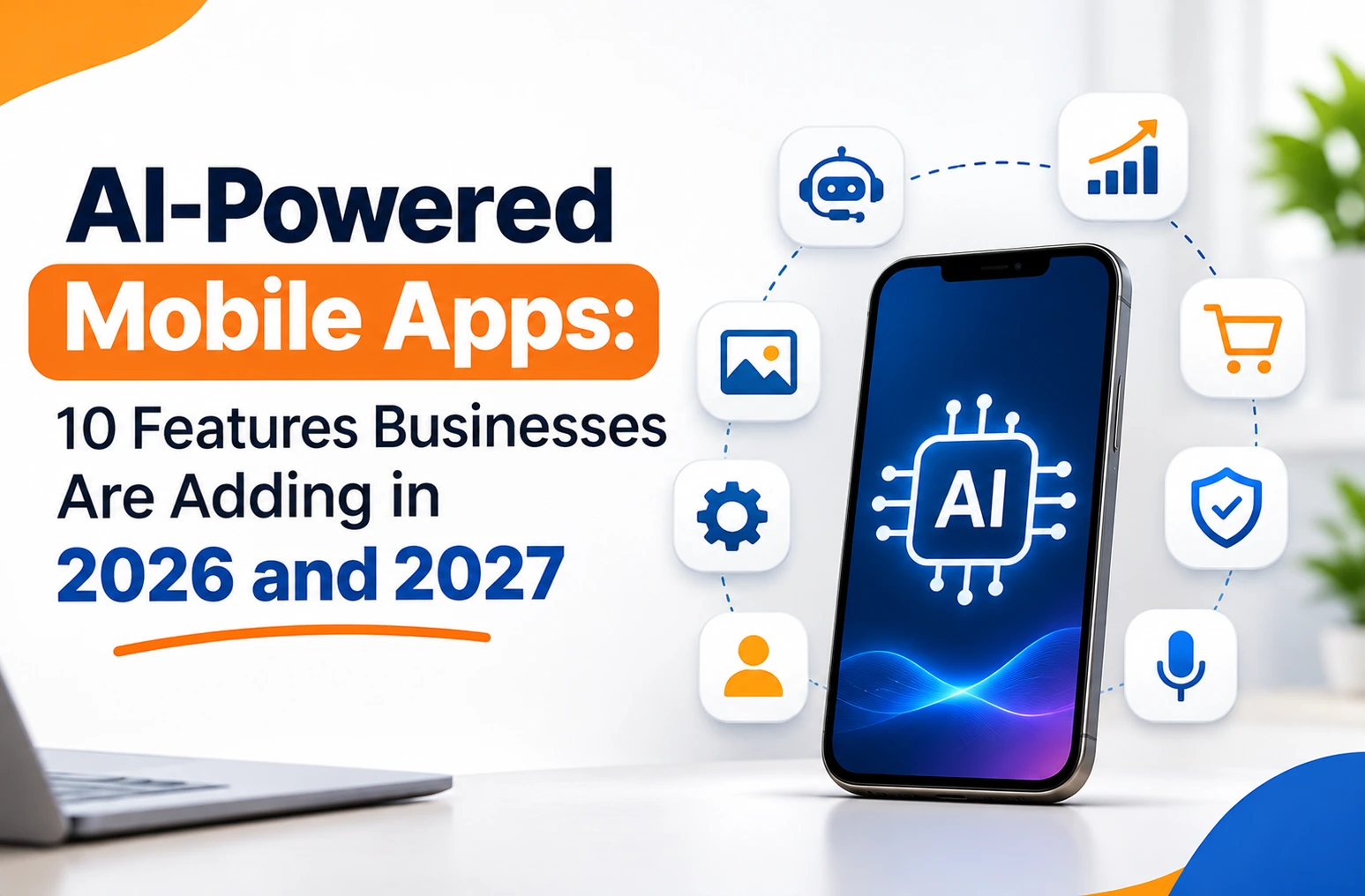
Quick answer: Enterprises are implementing features such as agentic AI, conversational search, personalization, predictive analytics, computer vision, on-device AI, fraud detection, voice & accessibility features, and generative AI & multimodal inputs into their applications. Pick one feature that addresses a particular user problem, test it, and then incorporate others. Some of the most recent products offered by Apple and Google are not available as yet and are only available for newer phones.
Artificial Intelligence has been changing the way businesses create mobile applications. Unlike traditional applications that were limited to presenting users with menus and forms, today’s mobile applications are capable of interpreting requests, suggesting choices, analyzing data, and even automating some actions. This applies to a wide range of industries, from retail to healthcare.
This information is provided by Shag Infotech, an IT and digital marketing firm based out of Jaipur. We have cross-referenced the details about the platform mentioned below through official Apple and Google announcements made in November 2026. This will be helpful in deciding upon investment options while seeking services for mobile app development.
Why Are Businesses Adding AI to Mobile Apps?
Short answer: To reduce steps and answer questions faster, tailor the experience to each user.
Conventional applications use rigid workflows: The user selects choices, manually enters data and performs tasks. With AI, the workflows can be made to be more adaptive and respond to the request, recognize patterns and even perform actions automatically. A shopping app could suggest relevant products while a services app could facilitate searches for appointments.
It is not about using AI for all situations, but to address problems, remove redundant actions, and enhance relevance.
What AI Tools Do Apple and Google Offer Developers Now?
Short answer: Both services now have on-device, cloud-based, and agent-assisted models, but there are some components that are only in preview mode at the moment. Availability also depends on the device and the location.
| Platform | Tool | Status (November 2026) |
| Android | AppFunctions | Experimental preview; lets an app share its tools and data with system agents |
| Android | ML Kit GenAI Prompt API with Gemini Nano 4 | Gemini Nano 4 is due on flagship devices later in 2026 |
| Android | Firebase AI Logic hybrid inference | Routes between on-device and cloud models, with modes such as prefer on-device or prefer cloud |
| Android | ADK for Android | First version available for experimentation; builds multi-agent workflows |
| Apple | Foundation Models framework | One Swift API for on-device models with image input, server models and custom skills (announced for iOS 27) |
| Apple | Core AI | New framework for running your own models on device |
These tools were introduced by Apple on June 8, 2026, along with the developer betas for iOS 27 being released the same day. According to Apple, the Apple Intelligence features can only be accessed from supported regions. The reports also suggest that the best on-device models will need newer devices with more memory.
10 AI-Powered Mobile App Features Businesses Are Adding
1. Agentic AI and Intelligent Workflow Automation
Short answer: An AI agent plans and performs several steps toward a goal using connected tools, while a basic chatbot only answers questions.
E-commerce applications could employ an agent that could help in verifying the order, get details of delivery and initiate a request for a refund. Business applications could also use agents for sorting out support tickets or searching the inventory.
The Google AppFunctions product line has been designed keeping in mind this transition, and the fact remains that it is a preview, experimental tool. Remember always to include permission and confirmation measures before allowing the agent to perform financial transactions and other such actions.
2. Conversational AI and Natural Language Search
Short answer: It lets users describe what they want in everyday words instead of choosing filters.
A person could search for “comfortable running shoes within my budget” using semantic search and find useful results. The areas that may help are:
- Online shopping.
- Online travel and accommodation services.
- Education platform.
- Customer service.
- Service directories.
Keep menus and traditional search available, because some users prefer familiar navigation.
3. Personalisation, Recommendations and Smart Notifications
Short answer: AI uses permitted activity and preferences to suggest relevant items and send timely, useful messages.
Products could be recommended by a shopping application by analyzing browsing history. Lessons could be recommended by a learning application according to user progress. Notifications can be set up to notify the user about an incomplete booking or frequent purchases made.
Be courteous. Let users have control over notifications and data settings and do not bombard them with messages. Be wary of dynamic pricing, as it causes mistrust in users.
4. Predictive Analytics and Smart Matching
Short answer: It uses past and live data to estimate what is likely to happen next.
- Delivery apps can match orders with available partners.
- Retail apps can predict product demand.
- Subscription apps can identify usage trends associated with cancellations.
- Booking apps can match availability with customer preferences.
Predictions are not guarantees. Their value depends on data quality, model accuracy and regular evaluation.
5. Computer Vision and Camera-Based Features
Short answer: It lets an app read images and video to identify objects, extract text or recognise patterns.
It is used by businesses for visual search of products, document scanning, virtual try on, product identification, quality checking and augmented reality. A consumer can take a photo of the product to look for similar products in a retail store.
Test accuracy in different lighting, image quality and device models before you launch.
6. On-Device AI and Hybrid Processing
Short answer: On-device AI runs supported tasks on the phone, which can cut network dependence, speed up responses and keep some data on the device.
Both of them are growing here. The ML Kit GenAI APIs of Google leverage the Gemini Nano for some specific tasks, while the Foundation Models of Apple allow Swift apps to utilize the local model used for Apple Intelligence.
Develop a hybrid approach by running simpler tasks locally and pushing more complex ones to the cloud model. In Android, the Firebase AI Logic can facilitate this process, while the same is possible via the Apple framework. But not all phones can execute the latest models; thus, create a fallback plan.
7. AI-Powered Fraud Detection and Security
Short answer: AI can flag unusual behaviour for review, but it must sit on top of normal security, not replace it.
Examples include irregular transaction trends, login alerts, fraudulently suspicious order requests, and any unusual activity in accounts. Ensure that encryption, authentication, access control and transaction verification are all working. Make use of the biometric security capabilities of the platform for login, instead of relying on AI predictions.
8. Voice and Accessibility Features
Short answer: Speech and language tools help more people use your app, including those who prefer talking to typing.
Examples are voice search, speech to text, read aloud, and captioning. These make your application accessible to different types of users. In the context of India, make sure to test the accuracy with different accents and regional languages, as well as provide an alternative in text form.
9. Generative AI for Content and Document Processing
Short answer: Generative AI creates or transforms content from instructions and approved information.
Examples may include document summary, message composition, product description, educational summary, data extraction from documents and question answering using the approved business information. The Enterprise application would be able to create highlights out of a lengthy report.
Check generated content for accuracy, especially in financial, legal and healthcare settings.
10. Multimodal AI and Connected Experiences
Short answer: Multimodal AI combines inputs such as text, images and audio in one request.
For instance, a consumer can take a picture, write what he is looking for, and receive suggestions. A maintenance application can allow the user to attach an image with a note in order to make a request for maintenance. The new framework from Apple allows one to use both image and text. The Android AI supports image, text and audio.
Which AI Features Should Different Businesses Choose?
Short answer: Pick the feature that fixes your users’ biggest problem, not the one that sounds newest.
| Business type | Useful AI features |
| E-commerce | Recommendations, visual search, conversational shopping |
| Healthcare | Document assistance, appointment support |
| Education | Personalised learning, content summaries |
| Banking | Fraud detection, transaction analysis |
| Travel | Smart search, itinerary help, matching |
| Logistics | Demand forecasting, delivery matching |
| Enterprise | Workflow automation, document processing |
Start with one feature, measure its performance and expand only when the results justify it.
What Should You Check Before Adding AI?
Short answer: Privacy, accuracy, security, performance, human oversight and running costs.
- Data privacy: gather just what you need and tell others how to use it. Look at your obligations under the Digital Personal Data Protection Act, 2023, of India and any laws in your industry.
- Accuracy: evaluate AI answers and predictions against real-life situations. Do not make an assumption that results are always right.
- Security: protect APIs, databases and accounts. Agents also need safeguards against prompt injection and unauthorised tool use.
- Performance: consider battery use, device compatibility, response time and cloud load.
- Human oversight: Add verification process for critical tasks and mechanism of contacting the individual.
- Store policies: Before submitting your project, do check the Google Play and Apple guidelines for AI capabilities and for any data sharing with third-party AI applications.
- Ongoing costs: include API usage, model hosting, monitoring and maintenance, not only the build.
How Much Do AI-Powered Mobile App Development Services Cost?
Short answer: There is no fixed price. Cost depends on app complexity, the number of AI features, the models you choose and your integrations.
The chatbot is simple compared to the creation of a recommendation engine and even an application with multiple agents. The cost drivers are as follows:
- UI/UX Design & App Development.
- Selection or development of AI Model.
- API Integration & Backend Infrastructure.
- Data Preparation & Management.
- Security & Performance Testing.
- Hosting, Monitoring and Maintenance along with per use AI charges.
Prior to reaching out to a development firm, create a list of features and what problems those AI-enabled features will address. This will help in comparing the proposals. Request an itemised estimate and perhaps even a small pilot run before the actual development.
How Shag Infotech Can Support Your App Plans
Adding AI takes more than choosing a model. You also need to think about user experience, architecture, integrations, security and long-term maintenance.
Shag Infotech is a Jaipur-based company offering app development, web design, SEO and digital marketing, so your app and its online presence can be planned together. If you are planning a new app or adding AI to an existing one, contact Shag Infotech with your requirements and ask for a scoped, itemised plan.
Frequently Asked Questions
What are AI-powered mobile apps?
These are applications that employ artificial intelligence in functions like suggestions, conversation, visual recognition, prediction, and task automation.
Which AI features are most useful for businesses in 2026?
Personalization, intelligent search, prediction, computer vision, on-device AI and agency-based workflow are all valuable. It is up to you to decide which one works for you based on your application and target audience.
Can I add AI to an existing mobile app?
Yes. You can integrate AI through APIs, cloud services or compatible on-device models. The best route depends on your app’s architecture and requirements.
Is on-device AI better than cloud AI?
Neither one is always superior. On-device AI can help with privacy and offline work on appropriate tasks, whereas the cloud AI can be helpful in more computationally heavy tasks.
Are Apple’s and Google’s newest AI tools ready for production?
Not all of them are, but some of them are not. The AppFunctions feature from Google remains an experimental preview feature and the Gemini Nano 4 version is expected to be released on flagship handsets in 2026.
How much does it cost to develop an AI-powered mobile app?
It depends on features, models, complexity, integrations, infrastructure and maintenance. You need a detailed project assessment for an accurate estimate.
Conclusion
AI is increasing responsiveness, personalization and the capability to do complex jobs in mobile apps. In 2026 and 2027, companies are considering agentic workflow, conversational search, predictive analytics, computer vision, on-device AI and multimodal interactions.
The key to success does not lie in trying out all new features at once. It involves picking the appropriate technology that solves an actual user problem while maintaining privacy, security and good performance. Choose one feature, implement it, measure the outcome and scale up.