


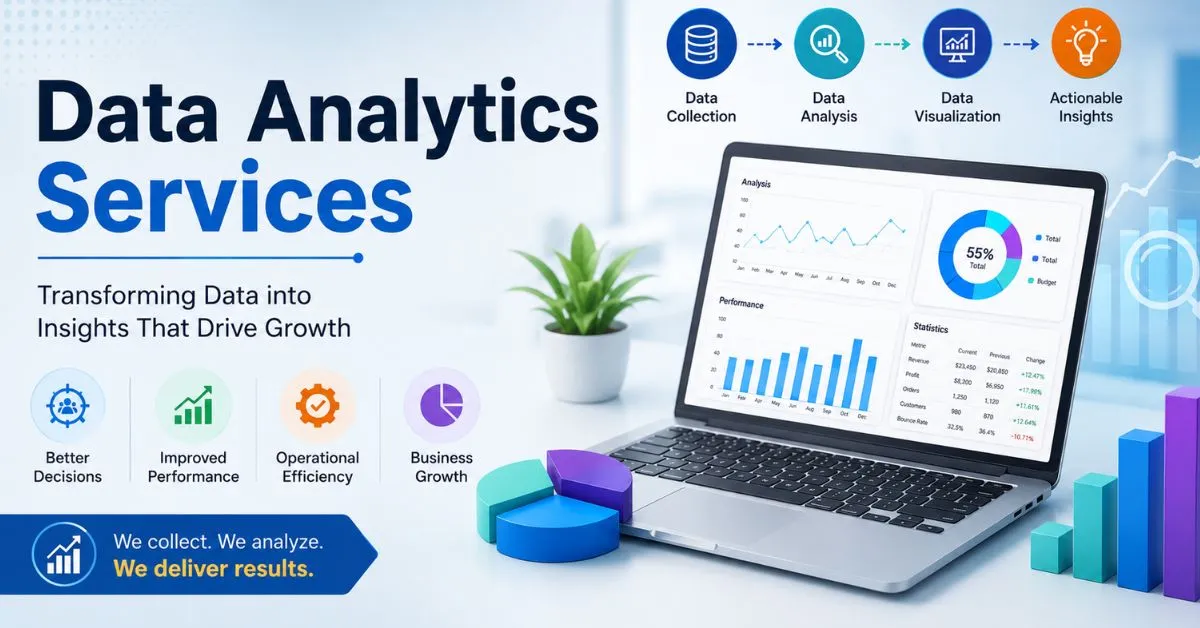
The business environment of today experiences rapid development. The business activities of companies generate massive amounts of data, which they produce every moment through their customer interactions, website data, sales information and marketing efforts. The main challenge of this process arises from the need to comprehend and apply collected information rather than from the task of gathering data.
Most businesses struggle because raw data alone has no meaning unless it is analyzed. This is where Data Analytics Services play an important role. They enable businesses to convert raw data into useful business insights for better decision-making, leading to growth.
In 2026, competition is extremely high. Businesses that rely on guesswork are losing opportunities, while data-driven companies are growing faster. That is why analytics has become a core part of modern business strategy.
What is Data Analytics?
Data analytics involves examining raw data to identify useful patterns and trends which provide insights that support enhanced decision-making. The process enables businesses to gain a deeper understanding of customer behaviour, market dynamics, and their overall business performance.
Data analysis enables organizations to transform extensive and intricate datasets into valuable insights. The sales data will show which product has the highest performance, while customer data will demonstrate their shopping habits and product preferences.
Modern companies utilize business intelligence tools to convert raw data into accessible dashboards, charts and reports. The visual insights enable managers to make business decisions with greater speed and improved precision.
Data analytics needs to be applied because it helps organizations to work more efficiently while boosting their financial results and enabling them to understand customer purchasing patterns. The method has found application in various fields, including marketing and finance, healthcare and e-commerce, to transform data into essential business insights.
Why Businesses Need Data Analytics Services in 2026
In 2026, businesses will rely on data analytics because digital data is growing rapidly and manual analysis is no longer effective. It helps companies stay competitive, make faster decisions, and understand customers better using modern AI and automation tools.
- Huge growth in digital data: Businesses create enormous data volumes every day through their online platforms, mobile applications and social media activities, which require statistical analysis to discover valuable business insights.
- Increasing competition in every industry: Data analytics is used by companies to understand various market trends, thereby helping organizations to work out strategies to stay ahead of competitors.
- Demand for faster decision-making: Businesses are looking for ways to make quicker and more informed decisions to improve results and performance. Real-time data can be very useful for businesses.
- Rise of AI and automation technologies: Tools based on artificial intelligence help simplify data processing and improve the prediction of future trends.
- Need for better customer understanding: Data analytics helps businesses study customer behaviour and preferences to improve products and services.
Businesses can now automate data processing using AI-powered analytics for instant, accurate insights.
How Data Analytics Improves ROI
The understanding of data analytics business applications, which demonstrate how data analytics improves ROI for businesses, has become crucial for modern companies because it generates revenue boosts, expense reductions, and productivity enhancements. The insights from data enable businesses to discover their successful areas and the parts which require enhancement.
With advanced tools and smart systems, companies can convert raw information into meaningful insights that support better decision-making. The organization uses this method to identify which strategies will generate the greatest returns and provide sustained success.
The accurate insights help businesses to achieve three goals because they enable fast market responses, performance improvements and profitable decision-making. The better resource utilization results in improved business outcomes for the organization.
Data analytics improves ROI in several ways:
- Helps in better marketing targeting
- Reduces unnecessary business expenses
- Improves customer conversion rates
- Optimizes business operations
- Identifies high-performing products/services
With Data Analytics Services, companies invest only in strategies that actually work, which increases overall profitability.
Key Benefits of Data Analytics in Business Growth
Today, businesses require smart insights and current technologies to drive their growth because these tools enable better decision-making and performance enhancement and create a competitive advantage. It supports strategic planning and efficient execution across all operations.
- Data-driven business decisions that reduce risks: When companies obtain precise insights, their decision-making capacity improves, which enables them to safeguard their operations against unpredictable events while decreasing their various business risks.
- Better understanding of customer behaviour: The act of expression includes the optimization of products, services, and customer practices.
- Improved efficiency in business operations: Intelligent systems, together with their insights, bring operational efficiency to businesses, which helps them to reduce time expenditures while boosting their overall work efficiency.
- Faster problem identification: Organizations around provide the capability to unearth problems for prompt mending before they affect the performance.
- Strong competitive advantage: The reason why companies lead the market is the knowledge and tools that enable them to make quick adjustments in an industry that experiences constant changes throughout the day.
Role of Predictive Analytics and AI
Modern businesses use advanced technologies like AI and predictive systems to improve decision-making and planning. Predictive systems help organizations forecast future trends using past patterns, such as predicting customer demand during festive seasons or identifying which products are likely to perform better. This improves accuracy, efficiency, and business planning.
Benefits of predictive analytics:
- Forecast future sales and demand
- Identify customer behaviour patterns
- Reduce business risks
- Improve inventory and supply planning
Along with this, AI powered analytics is making data processing faster and more accurate than ever before.
Real-Time Data Insights for Faster Decisions
In today’s fast-moving market, businesses cannot rely on delayed reports and need instant information to make quick decisions. Real-time insights help companies respond immediately to changes in demand, customer behaviour, or sales performance. For example, imagine a retail store setting up sales on the site, while adjusting prices to avoid loss and increase income at the same time.
Real-time data insights help companies:
- Monitor performance instantly
- React quickly to market changes
- Improve customer service
- Track marketing campaigns in real time
It raises the flexibility and competitiveness of businesses.
Marketing Analytics for Better Results
Marketing performance improves when businesses understand which strategies deliver the best results. The system enables organizations to evaluate their advertising performance through two main functions, which include tracking customer interactions and assessing their marketing campaign results. Marketing analytics helps businesses to decrease their wasteful spending while improving their conversion rates and gaining customer behaviour insights, which result in higher profits and better marketing performance.
- Tracking customer engagement: Interest is extracted from users’ engagement with ad views, posts, and campaigns.
- Measuring ad performance: Companies evaluate which ads generate clicks, leads, or sales to improve future campaigns.
- Improving conversion rates: Optimizing the Lander and offers have been instrumental in converting more browsers into customers.
- Reducing marketing waste: Business enterprises avoid pouring money into ineffective campaigns and tend only to concentrate on the strategies that bring in the highest sales.
- Understanding audience behaviour: Companies study customer interests and preferences to create more targeted and effective marketing.
Importance of Analytics Tools in Data Analytics Services
Modern businesses rely on advanced analytics tools, business intelligence, and AI powered analytics to process and visualize data effectively. These tools help organizations make data-driven business decisions and support business growth through data analytics by turning complex information into simple and actionable insights for better performance and results. They also allow instant data insights for businesses to quickly react to changes and improve precision in decision-making.
1. Google Analytics
Tracks website traffic and user behavior, helping businesses understand how users interact with their website.
2. Business Intelligence Tools
Convert complex data into simple dashboards and reports, making decision-making easier and more effective.
3. AI Powered Analytics Tools
Predict future trends and provide automated insights to support faster and smarter decision-making.
4. Data Visualization Tools
Present data in charts and graphs, making it easy to understand and interpret information quickly.
5. Reporting Tools
Generate automated reports that help businesses regularly monitor performance and track progress efficiently.
Business Intelligence and Data Strategy
Business intelligence systems enable organizations to transform their unprocessed data into usable dashboards and reporting solutions. The system provides business leaders with performance monitoring tools through key metrics, which they use to make fast, accurate decisions that result in better operational efficiency and improved business outcomes.
With strong data strategies, businesses can:
- Improve planning and forecasting
- Track performance continuously
- Identify growth opportunities
- Reduce operational risks
Business Growth Through Data Analytics
The main benefit of using analytics in businesses leads to their development over extended time periods. Business growth through data analytics happens when companies consistently use insights to improve operations, optimize strategies, and understand customer needs. The business environment, which operates in intense competition, benefits from this process because it enables better decision-making and efficient operations, while creating more revenue streams and driving business growth.
This includes:
- Better product development
- Stronger customer satisfaction
- Improved pricing strategies
- Faster market expansion
Challenges Without Data Analytics
Data analytics unavailability creates multiple decision-making problems for businesses while preventing them from understanding customers and operating their business activities efficiently. The absence of proper insights prevents companies from recognizing market trends, which leads to increased expenses and missed chances for expansion, thus decreasing their organizational effectiveness and competitive strength while making it harder to achieve ongoing business success.
- Poor decision-making
- High operational costs
- Missed opportunities
- Weak customer understanding
- Inefficient marketing strategies
Future of Data Analytics Services in 2026
Businesses will adopt more automated systems with advanced intelligent technologies because they need these solutions to remain competitive in the future. Companies will gain access to advanced data processing tools through the development of AI-based analytics, which enables them to achieve quicker results and enhanced analytical insights.
Fully automated reporting systems will decrease manual work requirements, while advanced predictive models will enhance trend forecasting accuracy. Real-time decision-making systems will enable businesses to adapt their operations to changing market conditions. The process will achieve better efficiency results because it minimizes operational risks while enabling sustainable business expansion.
Conclusion
In the current competitive environment of digital businesses, data has emerged as the most important asset for organizations. The companies that utilize Data Analytics Services for their operations will achieve better decision-making capabilities, together with improved operational efficiency and reduced cost expenditures, which will lead to higher return on investment.
Data has transformed into a powerful instrument which businesses use for creating new strategic plans and achieving their long-term goals. Businesses that utilize insights together with advanced technologies will achieve a distinct edge over their rivals. The organizations that implement analytics-based methods achieve sustainable market leadership from 2026 onwards.
FAQs
1. What are Data Analytics Services?
Data Analytics Services help businesses collect, process, and analyze data to find useful insights. These insights support better decisions, improve performance, and help companies grow faster in a competitive market.
2. Why are Data Analytics Services important for businesses?
They support businesses in understanding customer behaviour, observance of work quality, and feedback on strategies. This leads to better decision-making, reduced risks, and increased efficiency, helping companies stay competitive and grow sustainably.
3. Can beginners learn data analytics?
Data analytics is an accessible field for beginners who want to learn it. The combination of proper guidance, practical training and simple tools enables anyone to learn concepts which will help them develop strong analytical skills for their professional advancement.
4. How do Data Analytics Services improve ROI?
They help businesses discover effective strategies while decreasing unneeded costs, and they enhance their operational efficiency. Businesses that use insights for their operations will experience revenue growth, together with improved investment returns.
5. What tools are used in data analytics?
Common tools include Google Analytics, Power BI, Tableau, and Excel. The tools enable users to analyze data while they generate reports and create visualizations that help users understand information better and make decisions more quickly.
6. What is the difference between data analytics and data analysis?
Data analysis focuses on examining data. The field of data analytics requires data collection and processing work, which leads to producing insights that help businesses make better operational decisions.
7. Do Data Analytics Services support small businesses?
Yes, small businesses can use data analytics to understand customers, improve marketing, and make better decisions. It helps them compete with larger companies and grow efficiently.
8. What industries use data analytics?
Data analytics is used in many industries, such as marketing, finance, healthcare, e-commerce, and IT. It helps organizations improve performance and make data-driven decisions.
9. Is coding required for data analytics?
You can perform basic data analysis through Excel and Power BI without needing to write code. The process of advanced analytics requires users to learn programming languages like Python and R.
10. What is the future of data analytics?
The future uses artificial intelligence and automation together with real-time data analytics. Data will become the primary resource for businesses to make quicker decisions, which will enhance their operational efficiency and help them maintain their edge over competitors.