

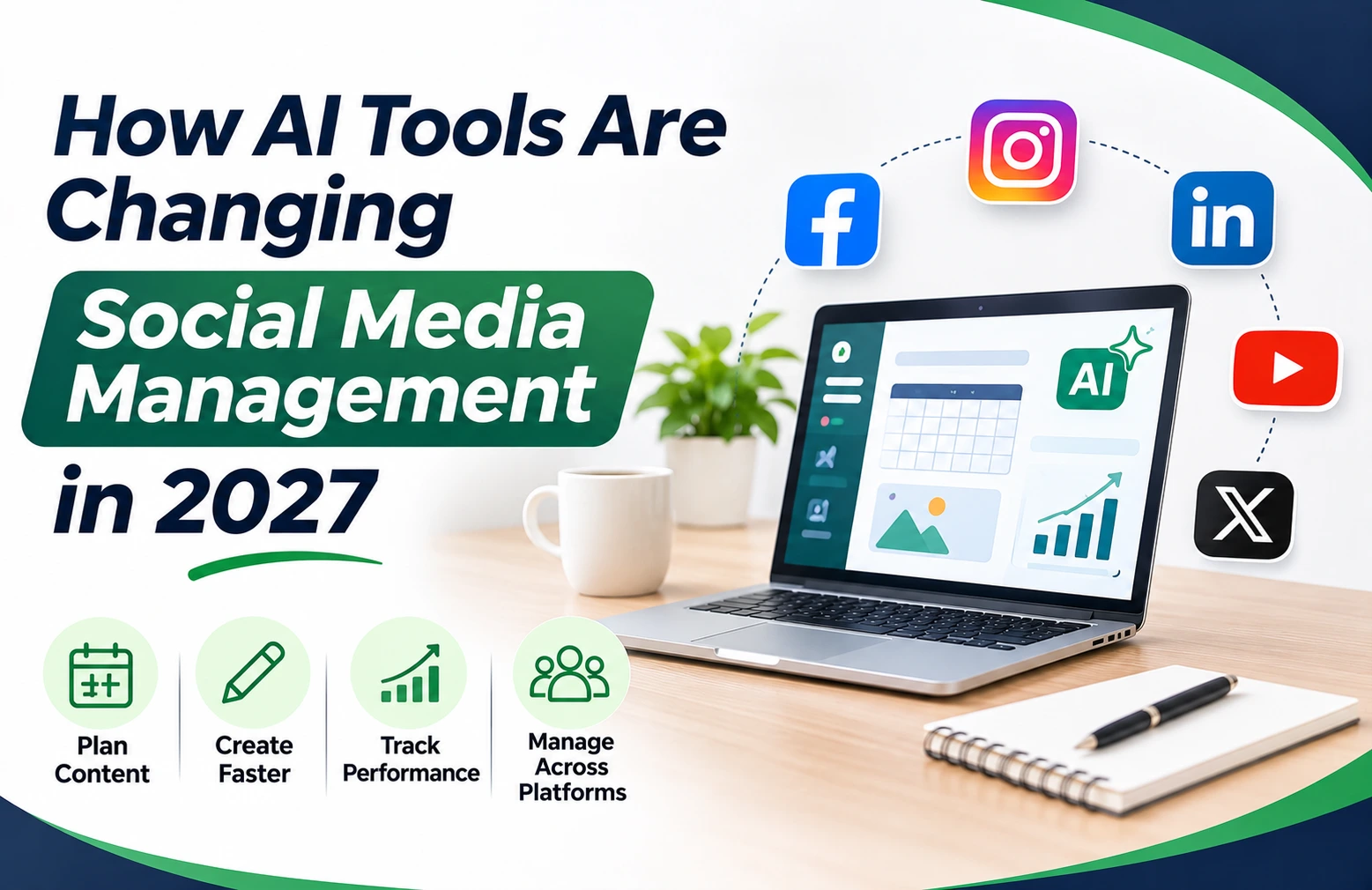
Social media marketing is becoming more complicated with many companies competing for attention on platforms such as Instagram, Facebook, LinkedIn, YouTube and others. Planning an interesting post, interacting with the clients, analyzing its performance and ensuring its consistency takes time and skills.
The advent of artificial intelligence is revolutionizing this process. More and more companies are turning to AI to help them with their social media efforts.
As 2027 approaches, social media management services are evolving from basic posting and scheduling into more data-informed marketing solutions. However, successful social media marketing still requires creativity, strategic thinking and an understanding of customer behaviour.
This guide will discuss how artificial intelligence is revolutionizing social media management, what tools companies can think about using, the services usually offered, and why human skills are still very relevant.
Why Is AI Becoming Important in Social Media Management?
The AI technology has become increasingly useful due to the necessity to run numerous social media accounts and produce content in various formats in response to changing tastes of their consumers.
Adoption is close to universal. Metricool reports that95% of social media professionals use AI in their work, and HubSpot’s survey of more than 1,100 marketers puts the figure at 94% In HubSpot’s data the top uses are ideation (42.9%), caption writing (41.5%) and image generation (38.35%).
This study revealed that 65% of the respondents save from one to six hours per week thanks to AI technologies.
For companies investing in social media management services, the opportunity is to reduce repetitive work while allowing marketing professionals to spend more time on strategy, creativity and customer relationships.
7 Ways AI Tools Are Transforming Social Media Management in 2027
The below developments are based on existing capability by 2026 and possible developments in 2027. The below developments are not predictions for future platform capabilities.
1. AI Makes Content Planning More Efficient
Social media planning includes conducting research on the subject, finding out about the target audience, scheduling content, and ensuring that there is brand messaging consistency.
The process can be assisted by the AI technology through providing topic ideas, structuring content pillars, and preparing the initial outline of the campaign.
For instance, an apparel brand can utilize AI to come up with content ideas related to seasonal styling, product education, and festivals.
But the marketers need to check these suggestions for accuracy, relevance, and originality because the content calendar has to be relevant to customers’ needs.
Business benefit: Faster planning with more time available for creative development and campaign execution.
2. AI Supports Personalised Content Creation
Different audiences react differently to different messages. For example, a marketing campaign designed for entrepreneurs will require professionalism, while for a fashion brand, caption and visual communication will work better.
AI technologies can assist in preparing many versions of captions and video scripts.
For instance, an enterprise working in India and the USA might require different strategies for content production depending on the language, culture, and regional events.
A skilled social media manager can use AI-generated suggestions as starting points before refining them to match the brand’s voice.
Personalisation should rely on appropriate audience insights and privacy-conscious data practices rather than assumptions about individual customers.
3. AI Is Changing Instagram Management
The Instagram platform needs an engagement of visuals, Reels, stories, captions, and social interaction.
AI-assisted Instagram management can support content ideation, caption drafting, visual concepts, audience analysis and performance reviews.
For instance, the restaurant can look at what kind of posts garner more saves or profile views, and conduct an experiment with behind-the-scenes clips, highlighting their menu or featuring customers.
Meta’s guide to AI includes the use of the technology in creating content calendar, competitive research, and captions generation.
Nevertheless, the AI cannot assure that a Reel will become viral or the right time to post it to get maximum engagement.
Business benefit: More structured content experiments and better use of available performance data.
4. AI Helps Businesses Respond to Customers Faster
Social media is no longer used just for brand marketing purposes. Social media is also used by consumers to ask questions and express issues. Messaging systems assisted by AI technology can help companies organize queries and answer questions raised by customers.
An e-commerce company, for instance, may get numerous queries regarding the time of delivery, refund policy, and product availability. An AI-assisted query handling system will allow answering regular questions and passing more complicated ones to the employees.
In cases of complaints, requests for refund, and other sensitive matters, human intervention is crucial. The aim is not to substitute human interaction in customer service with automatic replies but to improve the speed of communication.
5. AI Improves Social Media Performance Analysis
Analysis of social media outcomes entails more than just measuring likes and followers.
It is necessary for businesses to analyze engagement, website traffic, inquiries, conversions, and the quality of the engagement.
There are AI analytics platforms that could assist in recognizing patterns of posts, audiences, and campaigns.
For instance, a service-based company may find that educational videos yield more qualified inquiries than promotional images.
These insights can guide future content decisions.
A reliable social media management company should still validate the data and explain what the results mean for business goals.
AI can highlight correlations, but it cannot automatically prove that a particular post caused an increase in sales.
6. AI Supports Social Listening and Trend Research
Social listening is a practice where a business listens to conversations centered on brands, products, competitors, and industry issues.
Artificial intelligence can help the marketing department manage massive data, identify commonly asked questions, and identify emerging conversation topics.
For example, a skin care brand may notice customers asking about the ingredients often. In such a case, the company gets an opportunity to produce educational blog posts about the ingredients of their product.
Also, a regional services company will notice common customer complaints and create useful FAQs.
However, trends have to be managed properly as some of them do not fit all companies.
7. AI Is Making Advertising Workflows More Data-Driven
The innovation has also been impacting the area of paid ads on social networking sites. Companies like Meta are already utilizing machine learning algorithms in the area of ads.
In January 2026, Meta made an announcement about the new developments in its advertising products and made plans to develop them further via automation.
From the perspective of business entities, the utilization of such technology may simplify some activities.
However, in order to launch effective ads, one must properly budget, have specific objectives, good content, and conversion tracking.
A professional social media agency should explain how automated advertising features are used and how campaign results are evaluated.
AI Tools Businesses Can Consider for Social Media Management
Different tools support different stages of the social media workflow.
| AI Tool | Common Use | Business Value |
| ChatGPT | Content ideas, captions and scripts | Speeds up initial drafting |
| Canva | AI-assisted visual design | Supports creative production |
| Meta AI | Content research and marketing insights | Helps with planning and analysis |
| Hootsuite | Scheduling, analytics and social workflows | Supports multi-platform management |
| Sprout Social | Social listening, reporting and customer care | Helps organise audience insights |
These are just examples and not tools which must be used. The features and availability for subscription may vary.
It is better that companies decide on their own what tools to use, instead of subscribing to various platforms without any reason.
What Do AI-Powered Social Media Management Services Include?
Professional social media management services typically combine strategy, content creation, publishing, engagement and reporting.
AI may support these activities, but it does not eliminate the need for marketing expertise.
A comprehensive service package may include:
- Social media strategy: Identification of Objectives, Audiences, Platforms, and Content Themes.
- Content creation: Developing captions, graphics, Reels, and marketing content.
- Account optimisation: Improving profiles, descriptions and calls to action.
- Content scheduling: Maintaining a consistent publishing calendar.
- Community management: Monitoring comments, messages and customer enquiries.
- Performance reporting: Reviewing reach, engagement, traffic and conversions.
- Campaign optimisation: Testing content approaches and refining future activity.
It really depends on the service provider, business needs, and negotiated package.
AI vs Human Social Media Management: What Works Better?
AI and human knowledge play separate roles. The best strategy is often the use of both.
| Activity | AI’s Role | Human Role |
| Content ideas | Suggests topics | Selects relevant concepts |
| Caption writing | Produces drafts | Refines tone and accuracy |
| Visual content | Supports initial designs | Maintains brand identity |
| Customer replies | Handles approved routine responses | Resolves complex concerns |
| Analytics | Identifies patterns | Interprets business impact |
| Strategy | Supports research | Makes decisions and sets priorities |
AI is quite effective in repetitive activities. The professional will still remain accountable for judgment, creativity, accountability, and customer relations.
How Much Does Social Media Management Cost in 2027?
The social media management cost depends on the number of platforms, posting frequency, content requirements, advertising support and level of community engagement.
For example, an entrepreneur who has a need for content planning will need a different package than the e-commerce company dealing with daily Reels and queries from customers. The cost can also vary based on the cost of labor, among others, between India and the USA.
Before requesting a quotation, businesses should clarify:
- How many posts and videos are included?
- Is there any provision of content strategy and designing?
- Are any paid advertisement services included?
- Who will reply to customers’ queries?
- Which type of AI technology is used and what are its charges?
- How often will the performance reports be provided?
Do not select a vendor just because they offer you a lower price. Compare the deliverables and the business value they provide.
How to Choose the Right Social Media Management Company
Pick an organization that knows your industry and marketing objectives inside out. Analyze their portfolio, their content strategy, their reporting process, and their familiarity with AI marketing software. Read reviews from real customers and demand case studies too. With Shag Infotech, companies have access to digital marketing strategies which will help build their online identity.
What Are the Biggest Risks of Using AI in Social Media Marketing?
Although AI offers practical benefits, businesses should understand its limitations.
Inaccurate information: Incorrect information about the products can be present in AI captions.
Generic content: Too much automation may result in several brands sounding alike.
Privacy concerns: The upload of sensitive data of customers via unapproved apps is a danger to data security.
Brand inconsistency: It may not necessarily convey the tone or message of a corporation’s brand.
Overreliance on automation: Firms will risk losing their relationship with customers when each transaction is perceived to be mechanized.
However, the best approach is to formulate brand guidelines and perform a content review before publication.
Frequently Asked Questions
1. How is AI used in social media management?
It enables organizations to generate content, schedule posts, measure their performance and comprehend user behavior.
2. Which AI tools are best for social media management?
Examples of such applications include ChatGPT, Canva, Hootsuite, Sprout Social, and Meta AI.
3. Can AI manage Instagram accounts automatically?
AI can be used for captioning, content creation ideas, planning, and analysis; however, human input is always needed.
4. How much do social media management services cost?
Price is based on the number of platforms, frequency of content, creative demands, and campaign management.
5. Do small businesses need a social media management company?
A professional company is able to assist smaller companies in sustaining their content, reaching appropriate audiences, and managing social media campaigns.
6. Will AI replace social media managers in 2027?
AI could replace repetitive processes, but human creativity, planning, and customer interaction are vital elements.
Final Thoughts: The Future of Social Media Management in 2027
Artificial intelligence is revolutionizing social media marketing; however, the role of humans will continue to play an important part. Through the integration of intelligent technologies and social media marketing services, companies are able to optimize their content creation, increase customer interaction, and make wise choices. The secret lies in the responsible application of AI.