

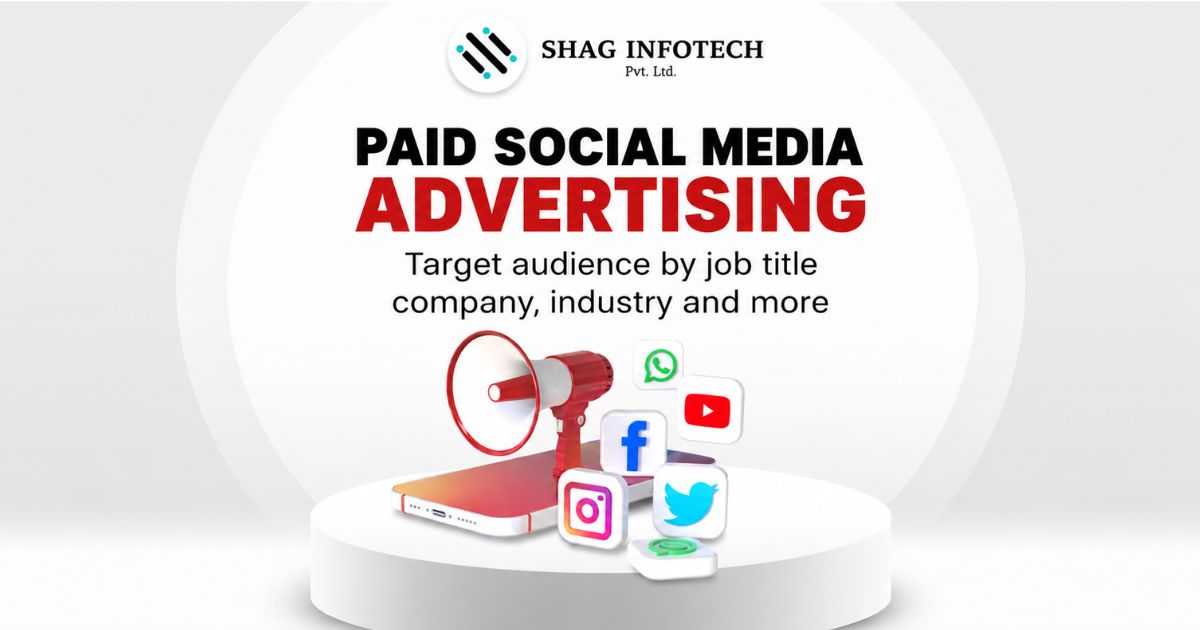
Paid Social Media Advertising has been one of the quickest and most effective means of reaching out to a targeted audience. In contrast to social media advertising, paid social media advertising gives organizations the ability to get their messages delivered to potential customers depending upon their demographics, interests, internet behaviour, and purchase intentions.
Increasing competition among businesses has made Paid Social Media Marketing essential for business growth. Whether businesses want to promote products or services, generate leads, or build long-term customer loyalty, paid campaigns help reach the right audience while delivering measurable results and a stronger return on investment.
Key Takeaways
- Paid campaigns allow businesses to connect with highly targeted audiences.
- There are various social media channels for various business purposes.
- Research on your target audience will enhance your campaigns.
- Optimization will boost the effectiveness of your ads.
- It is important to track performance through marketing metrics.
Table of Contents
- What Is Paid Social Media Advertising?
- Why Is Paid Social Media Advertising Important?
- Benefits of Paid Social Advertising
- How Paid Social Advertising Works
- Best Social Media Advertising Platforms
- Paid vs Organic Social Media
- Best Practices
- Common Mistakes
- Practical Business Example
- FAQs
- Conclusion
What Is Paid Social Media Advertising?
Paid Social Media Advertising is an online marketing technique in which organizations pay social media platforms to promote their products or services to a highly targeted audience. It helps brands increase visibility, generate qualified leads, drive website traffic, and achieve measurable business outcomes through a data-driven marketing approach.
Unlike free content, advertisers have the option of setting audience demographics, interests, behaviour, location, and purchase intent before running any advertisements.
The current Social Media Advertising platform makes use of artificial intelligence and machine learning to show advertisements to users interested in a particular business.
Campaign goals may be:
- Website Traffic
- Lead Generation
- Online Sales
- App Downloads
- Video Views
- Customer Engagement
- Product Promotion
One of the greatest strengths of paid advertising is total transparency of performance. Firms have access to all clicks, impressions, conversions and interactions with clients in real time.
Why Is Paid Social Media Advertising Important?
Paid Social Media Marketing is crucial since it enables enterprises to identify target audiences quickly, be more efficient in their campaigns, and gain marketing insights from those campaigns. Unlike using only organic reach, paid campaigns offer much more control and contribute to business growth.
The competition for organic visibility on social media platforms becomes even tougher as algorithms of the platforms favor personalization of content. Paid campaigns allow companies to bypass these difficulties and reach consumers who are interested in their offers.
Organizations usually adopt Paid Social Ads as part of their overall digital marketing campaign because paid campaigns have various goals such as generating leads, acquiring customers, traffic generation, launching new products, and remarketing.
Firms that regularly optimize their campaigns usually do well in terms of advertising performance.
Benefits of Paid Social Media Advertising
A paid social media campaign gives businesses greater control over audience targeting, faster campaign results, detailed performance analytics, and better budget management. With the right planning and strategy, Social Media Advertising Services help businesses attract new customers and improve marketing ROI.
Reach Highly Targeted Audiences
The most important benefit that comes with paid ads is targeted audience segmentation.
Companies can target their audience based on:
- Age
- Gender
- Interests
- Location
- Language
- Occupation
- Device Type
- Online Behaviour
This ensures that there is no money wasted on advertising.
Improve Business Visibility
Social media management and paid advertising work together to help organizations maintain visibility throughout the process.
When consumers are not ready to make the decision, repeated visibility helps build familiarity and trust.
Generate Leads Faster
Contrary to organic marketing techniques that can take up to several months to bear fruit, paid advertisements start to create impressions and attract traffic almost right away.
Paid advertisements are especially effective for:
- Product launches
- Seasonal promotions
- Event registrations
- Lead generation campaigns
- Service inquiries
Better Campaign Insights
Campaigns are accompanied by reports on performance to make it easier for marketers to comprehend the behaviour of their audiences and make future decisions.
Key performance indicators for the campaign are:
- Reach
- Impressions
- Clicks
- Engagement
- Conversion Rate
- Return on Ad Spend (ROAS)
These metrics will help companies constantly develop their advertising strategy.
Expert Insight (EEAT)
One major myth about paid advertising is that the bigger the budget, the better the outcome. On the contrary, the effectiveness of an advertising campaign will depend more on proper targeting of the right audiences and creating good creative elements as opposed to the budget allocation. Companies that frequently test various creatives and target audiences tend to perform well.
Industry Insight
New features such as artificial intelligence-based audience targeting, automated bidding, predictive analysis, and machine learning are being introduced by social media platforms on an ongoing basis. Companies that implement the mentioned tools together with a proper advertising strategy have a better chance of succeeding in acquiring customers and being efficient.
How Paid Social Media Advertising Works
The concept of paid social advertising involves showing ads to a well-targeted audience depending on the campaign goals, demographic characteristics, preferences, and online behaviour. Companies organize a campaign, set budgets, create advertisements, and optimize their performance in order to reach marketing targets.
In contrast to traditional advertising, social networks utilize machine learning and audience data to serve advertisements to users who have higher chances of engaging or converting. In this way, paid advertising becomes one of the most effective marketing channels nowadays.
A successful social media marketing campaign is typically organized following a certain algorithm.
Step 1: Define Your Campaign Goal
Each campaign must start by identifying a business goal.
Goals that can be set include:
- Brand awareness
- Website traffic
- Lead generation
- Product sales
- App downloads
- Customer engagement
- Video views
The choice of the right goal enables the advertising medium to deliver the campaign in the best way possible.
Step 2: Identify Your Target Audience
Knowing your audience is one of the most important things for your campaigns to be successful.
Companies can target users by:
- Age
- Gender
- Geographic location
- Interests
- Occupation
- Shopping behaviour
- Device usage
- Previous website visitors
The more relevant the audience is, the greater the chance of conversions
Step 3: Create High-Quality Advertisements
The quality of creative plays a major role in the success of a marketing campaign.
Good advertisements normally consist of:
- Strong headline
- High-quality images or videos
- Clear value proposition
- Short persuasive copy
- Compelling call-to-action
Experimenting with several creatives enables marketers to understand which advertisements work well.
Step 4: Set Your Advertising Budget
The advertising platform provides businesses with an opportunity to regulate their expenditure by defining daily or lifetime budgets.
Campaign budgeting should be consistent with:
- Marketing objectives
- Audience size
- Competition
- Expected conversions
- Business goals
Beginning with modest budgeting provides businesses with the chance to gather vital performance information before boosting advertising expenditure.
Step 5: Monitor and Optimize Campaigns
Campaign optimization is a continuous process and not a one-off task.
Companies need to keep track of:
- Click-Through Rate (CTR)
- Conversion Rate
- Cost Per Click (CPC)
- Audience Engagement
- Return on Ad Spend (ROAS)
Performance analysis helps to find areas for constant improvement.
Best Platforms for Paid Social Advertising
Each social media site comes with its own distinct benefits, target audience, and purpose. Choosing the correct platform will depend upon your target market, your marketing objectives, and your marketing budget, not just the popularity of the platform.
This is why Facebook continues to be one of the most popular advertising platforms due to its sophisticated audience targeting and campaign optimization features.
Companies may use the services of a Facebook advertising agency for the purpose of improving their campaigns and budgeting.
Facebook works well for:
- Lead Generation
- Local Businesses
- E-commerce
- Service Providers
- Small Businesses
Instagram is a visual platform that works well for brands marketing products in the lifestyle segment, fashion, travel, beauty, food, and consumer goods.
Effective ad types include:
- Stories
- Reels
- Carousel Ads
- Image Ads
- Video Ads
LinkedIn is perfect for business-to-business marketing when the target audience is professionals and decision-makers.
It can be used in the following types of campaigns:
- Lead Generation
- Webinar Registrations
- Recruitment
- SaaS Products
- Professional Services
YouTube
YouTube allows businesses to interact with their audiences using videos.
Some of its uses include:
- Product Demonstrations
- Educational Content
- Brand Storytelling
- Customer Testimonials
TikTok
TikTok offers great chances for organizations aiming to market themselves to a younger audience using creative short videos.
Creative storytelling tends to be more effective than normal promotional ads.
Paid Social Advertising vs Organic Social Media
Paid advertising offers instant visibility by marketing the content to specific target audiences, whereas organic social media involves creating long-term relations via consistent production and engagement in the community. The majority of companies tend to get better results when using a combination of both methods.
| Feature | Paid Advertising | Organic Social Media |
| Reach | Immediate | Gradual |
| Budget | Required | No direct advertising cost |
| Audience Targeting | Highly Precise | Limited |
| Speed | Fast Results | Long Term Growth |
| Performance Tracking | Advanced Analytics | Basic Insights |
| Lead Generation | Strong | Moderate |
Both of these work hand in hand and have to be incorporated within a Social Media Marketing Strategy.
Practical Business Example
A new online retailer of electronic products was trying to maximize sales of its recently introduced product range. Rather than relying on promotional advertising across a wide range of audiences, the company divided audiences into groups according to their interest, purchase history, and website visitors.
The marketing team also refined ad creative, experimented with several headlines, and optimized landing pages. In addition to the use of paid advertising campaigns, they also enhancedSocial Media Campaigns through informative content and testimonials from customers.
In just a couple of weeks, the company observed increased engagement, a better conversion rate, and an obvious rise inlead generation.
Expert Insight (EEAT)
Paid advertising success is not dependent upon budget size only. Companies that allocate time for researching their target audiences, testing ad creative, and optimizing their ads outperform companies that try to succeed with a bigger advertising budget without these actions. Experimenting, analyzing data, and understanding customers’ needs are the basis of successful campaigns.
Best Practices for Paid Social Media Advertising
The success of any paid campaign is maximized through proper strategizing, tracking its performance, and optimization using actual data. Testing, segmentation, and creative improvement will help optimize your campaigns to yield maximum ROI while promoting sustainable growth in your business.
Here are some best practices you can follow:
- Campaign goals need to be defined before starting any advertisements.
- Thoroughly research your target audience.
- Develop eye-catching imagery and appealing ad text.
- Experiment with multiple creatives and ad headlines.
- Landing page optimization is key to improving conversions.
- Monitor the performance of your campaign periodically.
- Successful campaigns can be scaled incrementally.
- Revisit your advertisements to keep audiences fresh.
A lot of companies also integrate Paid Advertising along with email marketing and SEO for developing an efficient digital marketing plan.
Measuring Campaign Success
Measuring the proper metrics can help companies gauge if their advertising budgets have led to tangible results for their businesses. Consistent measurement can also lead to better future campaigns by identifying areas of improvement.
The top metrics used in campaigns are:
- Reach
- Click-Through Rate (CTR)
- Conversion Rate
- Cost Per Click (CPC)
- Return on Ad Spend (ROAS)
- Customer Acquisition Cost (CAC)
Another vital measurement tool is Cost per Impression (CPM), which calculates how much it will cost to have an ad displayed a thousand times. Companies typically use CPM to analyze marketing campaigns that concentrate on exposure and not conversions.
Common Mistakes Businesses Should Avoid
Businesses fail at paid advertising because they do not reach their target audience, do not optimize their campaigns, and have unrealistic expectations. Not making these mistakes will increase the effectiveness of your advertising campaign.
Here are some mistakes to avoid:
- Starting a campaign with no objective.
- Using too wide an audience.
- Failing to conduct an A/B test.
- Utilizing poor-quality creatives.
- Directing traffic to slow-loading pages.
- Ending a campaign prematurely.
- Neglecting analytics and reporting.
Campaigns that succeed get better with time due to constant optimization rather than one-time changes.
Building Long-Term Brand Growth
Paid Social Media Campaigns should not revolve around direct sales. Those businesses that keep on investing in customer engagement and visibility tend to benefit from improved market positioning and customer trust, leading to sustainable growth.
Brand awareness among customers is one of the most important benefits of paid campaigns. Even though the user does not buy right away, frequent exposure makes them familiar with the brand.
Organizations that incorporate paid campaigns within their marketing strategies usually enjoy better customer retention and business performance in the long run.
Practical Business Example
An expanding online health and fitness company sought to register more customers before introducing its subscription plan. Rather than going for mass marketing, the marketers segmented their customers according to past web visits, health and fitness interests, and level of involvement.
The business collaborated with a top-notch Social Media Marketing Company that helped the company to refine its targeting and optimize the campaign. This was supplemented by the production of top-notch videos, customer reviews, and timely promotions.
After three months, there was an increase in traffic, leads, conversions, and customer engagement for the company. This showed how planning and optimizing a social media marketing campaign could generate business results.
Frequently Asked Questions
1. What is Paid Social Media Advertising?
Social Media Advertising is an advertising strategy that enables businesses to advertise on social media platforms by paying for it. This is useful because it increases visibility and helps to get leads and conversions.
2. Which platform is best for social media advertising?
Choosing the right platform depends on your company’s objective and target market. Facebook and Instagram would be appropriate for B2C companies, whereas LinkedIn is appropriate for B2B marketing, while YouTube and TikTok would work well for videos.
3. What is the difference between paid and organic social media?
While paid advertising creates instant visibility through the use of sponsored posts, organic social media aims at creating long-term engagement through constant posting of content.
4. Why are Social Media Marketing Services important?
Professional Social Media Marketing Services aid companies in developing their advertising plans and enhance their marketing results through audience targeting and optimization of campaigns.
5. How much budget is required for paid social advertising?
An advertising budget is dependent upon the objectives of the campaign, target audience, competition, and the industry involved. Companies need to start by setting realistic budgets and then optimizing their campaigns based on performance metrics.
6. Can paid social advertising improve business growth?
Yes. A properly managed paid campaign assists businesses in acquiring quality leads, driving traffic to their websites, and increasing customer acquisition to boost revenue.
Conclusion
Paid Social Media Advertising has become an essential strategy for businesses to reach high-quality customers and drive business growth through conversions. Success depends on choosing the right platform, understanding customer behaviour, creating compelling ad creatives, and continuously optimizing paid social campaigns for better performance.
Businesses that use paid campaigns in combination with good online advertising solutions have higher chances of making their marketing more efficient in today’s digital world.
For businesses that want to grow their campaigns with the help of professionals, Shag Infotech provides custom-made digital marketing solutions aimed at enhancing the performance of your ads and gaining business growth.