

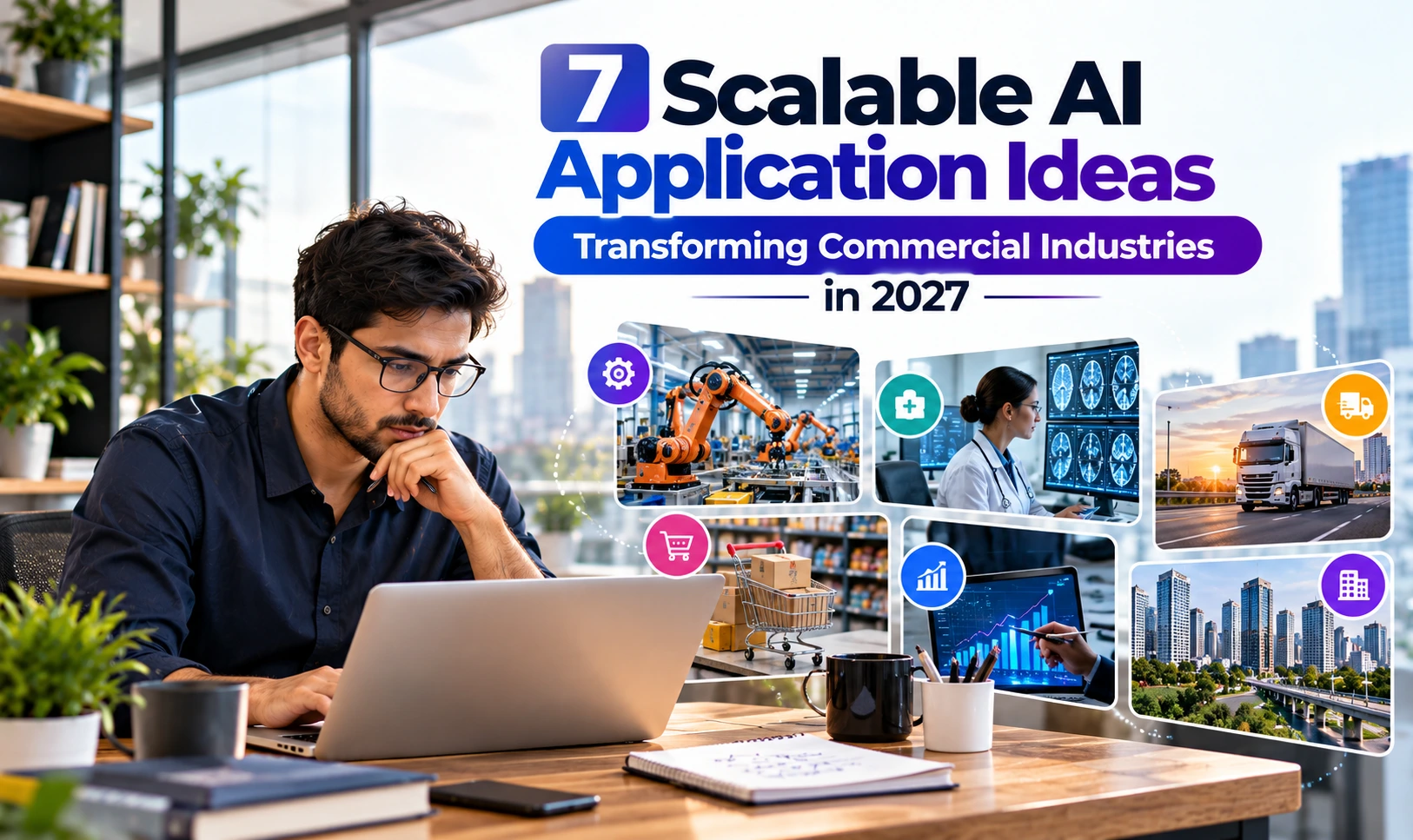
AI is evolving past the era of chatbots and automation. Corporations use artificial intelligence to analyze operational data, identify problems, and help make decisions faster. By 2027, some of the most valuable uses of AI would include its applications that are created in response to industry-specific challenges.
Before approaching an AI app development company, identify the process you want to improve. Is it reducing equipment downtime, managing patient appointments, forecasting demand or preventing delivery delays? A clear business problem helps determine the data, features and integrations an application needs.
1. AI-Powered Healthcare Management Applications
Health care professionals coordinate appointments, patient history, imaging, and resources available at hospitals every day. These processes can be made easier through the use of AI technologies that will minimize administrative duties and assist professionals in making well-informed decisions. For instance, a hospital application can analyze admissions to determine the number of beds needed.
An AI app development company can build solutions with features such as appointment forecasting, patient reminders, clinical-note transcription and resource management dashboards. Secure system integration, patient privacy, clinical validation and human oversight remain essential for safe healthcare applications.
2. Predictive Maintenance Applications for Manufacturing
Equipment malfunctioning without warning can stop the production process and cause delays and higher repair expenses. Predictive maintenance solutions employ data from machinery to detect anomalies that may suggest machinery issues.
A manufacturing solution would detect vibrations, temperatures, pressures, and energy consumption. When machines start deviating from their usual performance, the system can alert maintenance personnel about potential problems to perform an inspection and record the issue.
Important features include:
- Real-time equipment monitoring
- Anomaly and fault alerts
- Maintenance scheduling
- Spare-parts planning
- Equipment performance reports
For the above technique to function effectively, businesses require sensor data that is precise, as well as records of maintenance that are accurate. Poorly set up sensors can cause inaccurate predictions.
3. Personalised Retail and Ecommerce Applications
The retail industry gathers data through product views, searches, sales, return transactions, and support calls. AI algorithms can analyse this data for better product recommendations and insights into evolving customer preferences.
For instance, a recommendation tool on the ecommerce platform could generate suggestions based on customer’s browsing patterns, past purchase trends, and inventory availability. On the other hand, the forecasting tool could predict quick-selling items during the season.
Useful features include:
- Personalised product recommendations
- Smart product search
- Demand forecasting
- Inventory alerts
- Customer review analysis
They must be able to track the recommendations made to avoid suggestions that are repetitive or unrelated. They should also make sure their customers understand the use of their information.
An AI app development company can connect recommendation models with ecommerce platforms, customer databases and inventory systems. This integration helps retailers use existing business information instead of maintaining disconnected tools.
4. Financial Operations and Fraud Monitoring Applications
Banks, fintech companies and finance departments handle transactions that require accurate monitoring. AI app development company can build applications that identify unusual payment patterns, support fraud monitoring and simplify financial operations. For example, a transaction-monitoring system can compare current payments with historical activity and flag unusual amounts, locations or frequencies for investigation.
Among other helpful functionalities, invoice data extraction, cash flow prediction, payment reconciliation, and financial risk dashboards can be mentioned. Nevertheless, for a transaction marked as suspicious by an algorithm, human analysis, understandable warnings, safe data processing, and frequent model validation are required.
5. Intelligent Logistics and Supply Chain Applications
Potential features include:
- Delivery-time prediction
- Route optimisation
- Warehouse demand forecasting
- Supplier delay alerts
- Fleet performance monitoring
Recommendations should remain editable because road closures, customer requests and other live conditions can change a delivery plan. AI mobile app development can also help drivers receive route updates, capture proof of delivery and report problems directly from the field.
6. AI-Based Construction Project Management
Construction involves contractors, altered timetables, material needs and site conditions. It can be challenging for project managers to detect any potential delays with information scattered in spreadsheets, phone calls and text messages.
An artificial intelligence-based project management system would be able to compare expected schedules and site updates, recognize the risks and predict material needs. Image recognition could also assist with the evaluation of the visual construction progress, while the site inspection should still be done by professionals.
Useful features include:
- Project schedule forecasting
- Material requirement planning
- Site progress tracking
- Construction document search
- Safety observation alerts
Businesses should decide how site information will be collected and who will verify it. Starting with one workflow, such as progress reporting, is more manageable than trying to automate an entire construction project at once.
7. Generative AI Applications for Agriculture and Food Production
Agriculture depends on weather, soil conditions, crop health, storage and market demand. AI applications can combine these inputs to help farmers and food producers make better-informed decisions.
For example, a crop advisory application could analyse field images, local weather information and soil readings to flag possible crop stress. A food processing business could use demand forecasting to plan raw-material purchases and reduce avoidable waste.
Useful features include:
- Crop-image analysis
- Irrigation guidance
- Weather and pest alerts
- Harvest forecasting
- Food demand planning
In developing generative AI applications, the conversation interface may help explain technical information in more understandable terms. But the recommendations have to be based on credible and local data and reviewed by agricultural specialists. Recommendations cannot be the same for everyone, but should vary from crop types to climate and farming methods.
What Makes an AI Application Scalable?
Just because a pilot has been executed successfully does not necessarily mean that the program is scalable for thousands of people.
- Define a clear goal: Select a quantifiable problem that the software should be able to address.
- Check data quality: Ensure business data is accurate, accessible and secure.
- Plan integrations: Identify the existing systems the application needs to connect with.
- Prioritise security: Include access controls, encryption and human oversight.
- Monitor performance: Monitor the precision, utilization, expenses, and outcomes in business.
A capable AI app development company should discuss these requirements rather than focus only on demonstrating a model. Its AI app development services should cover discovery, data assessment, integration, testing, deployment and ongoing monitoring. Businesses considering AI mobile app development should also assess offline access, device security and usability for employees working outside the office.
How Should a Business Choose the Right AI Application Idea?
Compare each of them according to their business value, availability of data, cost of development and risk. For instance, an organization having good sensor data can use predictive maintenance, whereas one with organized customer data can focus on personalized recommendations.
If you have insufficient data, work on data gathering before going for the development. First, conduct a small-scale pilot, then analyze its results and scale up only if it brings value. An experienced company that provides AI applications development services can assist you with choosing the use case and making an appropriate roadmap.
For applications that generate content or responses, generative AI app development should include accuracy checks and human review to reduce incorrect outputs.
Frequently Asked Questions
1. Which industries can benefit from AI applications in 2027?
Healthcare, manufacturing, retail, finance, logistics, construction, and agriculture can employ AI for forecasting, work flow support, anomaly detection, and decision-making support. The most appropriate application will depend on the problem and data available to the firm.
2. What is the first step in developing an AI application?
Choose one business issue, and the improvement in performance that is expected. Evaluate the availability of data, existing software, user requirements, security needs and success criteria.
3. Does every AI application need generative AI?
Wrong. Predictive models, recommendation systems, computer vision, and anomaly detection might be more appropriate in many cases. Generative AI can be helpful where the application requires generation and summarization of information or natural language interactions.
4. How can a business make an AI application scalable?
Utilize modular architecture, robust data pipelines, secured integration, and performance measurement. Start with a concentrated pilot, evaluate outcomes, and scale-up when the system works steadily.
5. How should a business select an AI development partner?
Examine experience, data security, integration, testing approach, and after launch support. Request a defined scope, limitations, schedule, and deliverables.
Conclusion
AI-based applications have the potential to aid organizations in making their planning processes better and reduce repetitiveness and operational responses to change. Value is derived from addressing a specific issue and not just by including AI in every possible scenario.
Pick one that makes sense for you based on your data, team, and business needs and test it out through a carefully planned pilot. Measure its outcomes and then expand only if you see real value from it. If you are thinking of building an AI-based product, let us at Shag Infotech know about your use case and other technical specifications.