

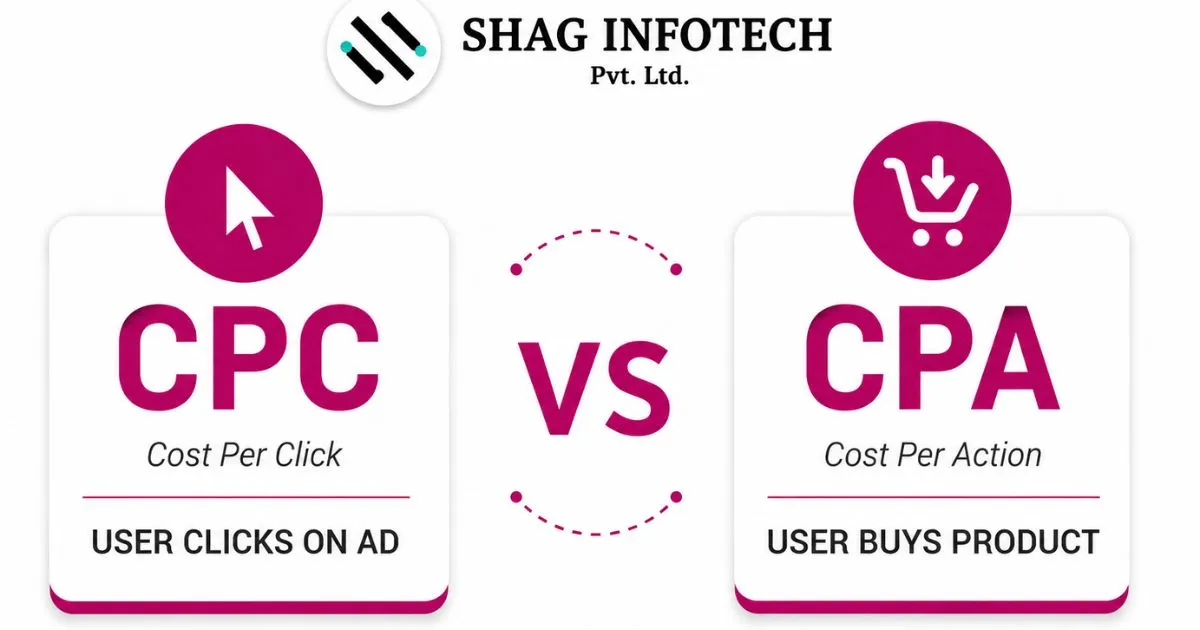
CPC (Cost Per Click) and CPA (Cost Per Acquisition) are two of the most widely used online advertising pricing models. CPC is ideal for driving website traffic and increasing brand awareness because advertisers pay for every click. CPA focuses on conversions, where advertisers pay only when a specific action such as a purchase, lead, or sign-up is completed. The right model depends on your campaign goals, budget, and desired return on investment (ROI).
It is very important for companies using digital marketing to know the difference between CPC and CPA. Both pricing models are useful in budgeting, but their approaches to measuring the success of campaigns differ. The choice should be made based on the purpose of the campaign.
No matter whether you start advertising through Google Ads, social networks, or display advertisements, your choice of bidding will affect your advertising costs and profitability. This article will help you learn what the difference between CPC vs CPA is, what their benefits are, and when it is better to use one or another bidding method.
Key Takeaways
- Both CPC and CPA are the most common online advertising pricing methods.
- These methods facilitate different aims for campaigns.
- Bidding tactics will vary based on the needs of the business.
- Effective tracking ensures better advertising results.
- Comprehending campaign metrics leads to greater returns.
Table of Contents
- What is CPC?
- What is CPA?
- CPC vs CPA: Key Differences
- When Should You Use CPC?
- When Should You Use CPA?
- Comparison Table
- Best Practices
- Common Mistakes
- Practical Example
- FAQs
- Conclusion
What is CPC?
Cost Per Click (CPC) refers to an advertising cost structure whereby the advertiser pays for each click-through from an advertisement. CPC campaigns are mostly used to drive traffic, build awareness, and capture potential customers while being in charge of how much you advertise.
In a Cost Per Click (CPC) campaign, the advertiser pays for every single user interaction through clicks. The exact price of the CPC campaign varies depending on several elements, including keyword competition, quality score, industry, and bidding strategy.
The business will usually consider a CPC campaign when the main goal is getting the users to the landing pages, blog posts, product pages, or service pages.
Advantages of CPC
- Control over the advertising budget
- Quick generation of traffic
- Easy to optimize campaigns
- Works well for awareness campaigns
- Instant visibility
What is CPA?
Cost Per Acquisition (CPA) is a payment method whereby advertisers are charged only once the user has performed the pre-defined task, like purchase of a product, filling out a form, or registering for a particular service. It is all about results and not just traffic generated by the site.
The use of Cost Per Acquisition (CPA) enables businesses to create campaigns that revolve around conversions and not clicks. Because advertisers get paid only when customers do something valuable, CPA campaigns are thought to be more effective.
Conversion Tracking is crucial for CPA Campaigns because it tracks business results like purchases or registrations.
Advantages of CPA
- Reduced financial risk
- Improved return on investment
- Results-oriented focus
- Quality leads
- Optimization driven by performance
CPC vs CPA: Key Differences
However, both models work well for advertising. The main difference between CPC and CPA lies in their purposes for use. The primary purpose of CPC is to generate traffic, whereas CPA concentrates on acquiring customers. It all comes down to choosing the right one.
| Feature | CPC | CPA |
| Payment Method | Pay Per Click | Pay Per Conversion |
| Main Objective | Website Traffic | Customer Acquisition |
| Risk Level | Medium | Lower |
| Budget Control | High | Moderate |
| Best For | Brand Awareness | Lead Generation & Sales |
CPC vs CPA knowledge enables businesses to be more efficient with their budget for advertisements and also enhance their marketing performance.
When Should You Use CPC?
CPC marketing campaigns are more effective when a company wants to boost its website traffic, visibility, or promote new products or services. Such a campaign is very effective in the early stages of the customer’s buying journey.
Who Should Use CPC?
- Businesses focused on brand awareness
- Bloggers and content publishers
- New websites looking to increase traffic
- Companies launching new products or services
- Businesses testing new advertising campaigns
Most advertisers have integrated CPC campaigns with successful Audience Targeting to make sure that advertisements are targeted at the right users.
When Should You Use CPA?
CPA campaigns fit well when companies want to achieve quantifiable business results like sales, sign-ups, or even quality leads. With CPA, advertisers get to fine-tune their campaigns with a view to making profits and not just generating traffic.
Who Should Use CPA?
- eCommerce businesses
- Lead generation companies
- SaaS businesses
- Service-based businesses
- Companies focused on conversions and ROI
Many businesses implementing advanced Google Ads Bidding Strategies choose the Target CPA bidding method for automated campaign optimization and predefined costs of acquiring customers.
Expert Insight (EEAT)
Commonly, many marketers confuse CPA and CPC as competitive approaches in advertising campaigns. It turns out that the most successful businesses tend to combine both approaches when it comes to implementing certain aspects of their marketing strategy. The fact is that CPC is effective for gaining audience traffic, but CPA works better with mature campaigns.
Industry Insight
Machine learning algorithms have become more common within modern advertising tools when optimizing bid choices. The automated bid solutions can take into account hundreds of real-time factors, which allows for increased efficiency and optimization of campaigns without making manual changes.
Factors That Affect CPC and CPA
CPC and CPA are affected by many factors like competition, quality of traffic, relevancy of ads, landing page experience, and campaign optimization. Knowing all these variables enables businesses to manage their advertising costs effectively while enhancing their campaigns’ efficiency.
The following factors greatly affect advertising costs:
Keyword Competition
More competitive markets tend to have higher advertising costs since there are many advertisers fighting for the same attention.
Quality Score
Google gives better quality scores to advertisements that are related, which usually means reduced advertising costs.
Landing Page Experience
Having a quick, relevant, and easy-to-use landing page will increase conversions without wasting any advertising money.
Target Audience
Audiences that are well-defined help attain better campaign results as compared to broader audiences.
Businesses that are consistent in monitoring Digital Marketing Metrics are better placed to spot opportunities for optimization.
Which Model Is Better for Your Business?
No one method is the superior approach to either CPC or CPA. Your choice should be based on your marketing goals, the stage of development of your campaign, the information you have access to, and general business objectives.
Choose CPC If You Want To:
- Drive website traffic
- Boost brand awareness
- Create a new business
- Promote blog posts
- Test new campaigns
Choose CPA If You Want To:
- Produce qualified leads
- Boost online sales
- Enhance profitability of marketing
- Expand successful campaigns
- Concentrate on measurable business growth
Most companies consider the Online Advertising Costs before coming to a conclusion about the pricing system that suits their campaign goals.
CPC vs CPA Comparison Table
It will become easy for you to know which pricing method suits your advertising goals if you compare CPC and CPA head to head. Both have their pros according to different advertising requirements.
| Comparison | CPC | CPA |
| Payment | Per Click | Per Conversion |
| Campaign Goal | Website Traffic | Sales & Leads |
| Budget Control | Excellent | Good |
| Conversion Focus | Low | High |
| Data Requirement | Minimal | Requires Conversion Data |
| Best Stage | Awareness | Decision & Purchase |
| Risk | Medium | Lower |
| Ideal Business | New & Growing | Established Businesses |
How to Improve Campaign Performance
When an advertiser analyzes the data consistently and optimizes their creative and targeting efforts, as well as conversion performance, the performance of their campaigns will be enhanced.
Below are some of the successful techniques that can be used for the optimization process:
Improve Ad Relevance
Use ads that are aligned with user search intent.
Optimize Landing Pages
Pages should be fast-loading and include compelling calls to action.
Refine Targeting
Update audience segments depending on campaign results.
Test Different Creatives
Test different headlines, images, and calls to action.
If you want your business to increase conversions,you must constantly optimize all stages of the customer journey and not just the ads.
Expert Recommendation (EEAT)
However, expert marketers do not normally rely on only one kind of bidding strategy for their entire advertising campaign. First, they will start with CPC campaigns to gather information about the target audience and how much it converts. After they get enough data, they will switch to CPA bidding to increase the efficiency of their campaigns.
When Should Businesses Switch from CPC to CPA?
Companies should think about moving from CPC to CPA once they have collected sufficient information about conversions for automatic optimization. The presence of a correct conversion history will allow advertisers to manage their campaigns better and increase ROI.
Indicators that companies are ready to change include:
- Stable history of conversion
- Constant flow of website visitors
- Proven tracking system
- Proven performance of campaigns
- Sufficient monthly conversions
Performance indicators such as Cost Per Conversion are frequently used by advertisers to assess the effectiveness of their CPA bidding strategy.
Practical Decision Checklist
Before deciding on your bidding model, you should ask yourself:
- Do I want to generate traffic or conversions?
- Do I have accurate conversion tracking set up?
- Am I creating a new campaign?
- Do I have sufficient past campaign data?
- Is my advertising budget flexible?
- Which business objective is important?
Many businesses also engage with experts who provide Advertising Consulting to find out which bidding approach is the most appropriate one.
Best Practices for CPC and CPA Campaigns
Ad campaigns need constant optimization, proper tracking, refining of the target audience, and making decisions based on facts. Regardless of whether you go for CPC or CPA, it is always helpful to apply best practices in order to optimize your campaign.
Here are the best practices:
- Set clear campaign objectives before running ads.
- Implement conversion tracking properly.
- Test various ad creatives frequently.
- Optimize your landing pages.
- Check your campaign performance on a weekly basis.
- Narrow down your audience targeting through data analysis.
- Budget your ad spend in line with your campaign objectives.
- Scalable campaigns are only successful.
PPC Optimization Services are usually sought by businesses to ensure that their bidding strategies improve and they are able to maximize their advertising investments.
Common Mistakes to Avoid
A lot of advertisers do not see any profit from their campaigns due to the following reasons: concentrating exclusively on clicks, ignoring data on conversions, or making changes to the campaign too often. This will help avoid mistakes and make profitable ads.
Here are the common mistakes you should avoid:
- Selection of the wrong bid strategy.
- Non-existent conversion tracking.
- Targeting too wide an audience.
- Driving traffic to under-optimized landing pages.
- Changing budgets daily with not enough data.
- Campaign report ignorance.
- Click-through rates priority at the expense of business results.
- Not testing different ads.
Knowledge about Advertising Pricing Models before the launch of any campaign enables organizations to plan their budgets wisely.
Practical Business Example
This eCommerce firm, which was steadily growing, aimed to boost its sales through the internet while keeping its advertisement spending under control. At first, the firm started Google Ad campaigns with CPC bidding to gain visitors and learn more about their behaviour.
Once enough conversion data had been collected, the firm started using Target CPA bidding. Landing page optimization, audience targeting improvement, and ad relevancy enhancement were also done.
The firm reached:
- Higher conversion rate
- Higher lead quality
- Lower customer acquisition costs
- More efficient advertising
- Online revenue increase
- Optimized budget management
The firm also tracked Cost Per Lead (CPL) along with Cost Per Action (CPA) to assess the efficiency of lead generation for different advertising campaigns. This helped in determining the most effective marketing channel for future investment purposes.
Frequently Asked Questions
1. What is the difference between CPC and CPA?
The key difference between CPC and CPA is the fact that CPC billing is done on a per-click basis, whereas CPA billing happens only after the specified conversion action is completed.
2. Which is better: CPC or CPA?
In terms of which one is better, neither one is. CPC works well for traffic generation and brand awareness, whereas CPA is more useful for conversion-oriented businesses.
3. Can beginners use CPA bidding?
Yes; however, CPA campaign performance typically improves after the advertiser gathers sufficient data on conversions. CPC campaigns tend to be used initially by beginners.
4. How can I reduce advertising costs?
Ways to decrease ad expenses include increasing Quality Score, enhancing landing pages, perfecting targeting, ad testing, and regular analysis of the campaigns.
5. Does CPA always generate better ROI?
No. The effectiveness of campaigns depends on many factors, including the quality of the target audience, conversion tracking, landing pages, etc.
6. Can CPC and CPA be used together?
Yes. Quite often, businesses use CPC campaigns first in order to gather traffic and conversion data and then switch to CPA bidding.
Conclusion
The CPC vs CPA debate is not about choosing one system over another; rather, it’s about using the right approach according to your marketing objectives. CPC works effectively when the aim is to attract more visitors, whereas CPA helps in generating some measurable results such as conversions, registrations, and sales.
The organizations which keep track of their campaigns, work on landing pages, target the audiences effectively, and make sure that their conversion tracking is accurate tend to perform well in the long run. In many cases, it has been observed that with the passage of time, the combination of both CPC and CPA approaches provides the most desirable results.
In case you want to enhance the performance of your paid ads, feel free to take assistance from Shag Infotech for optimizing your bidding and gaining business success through advertising.