

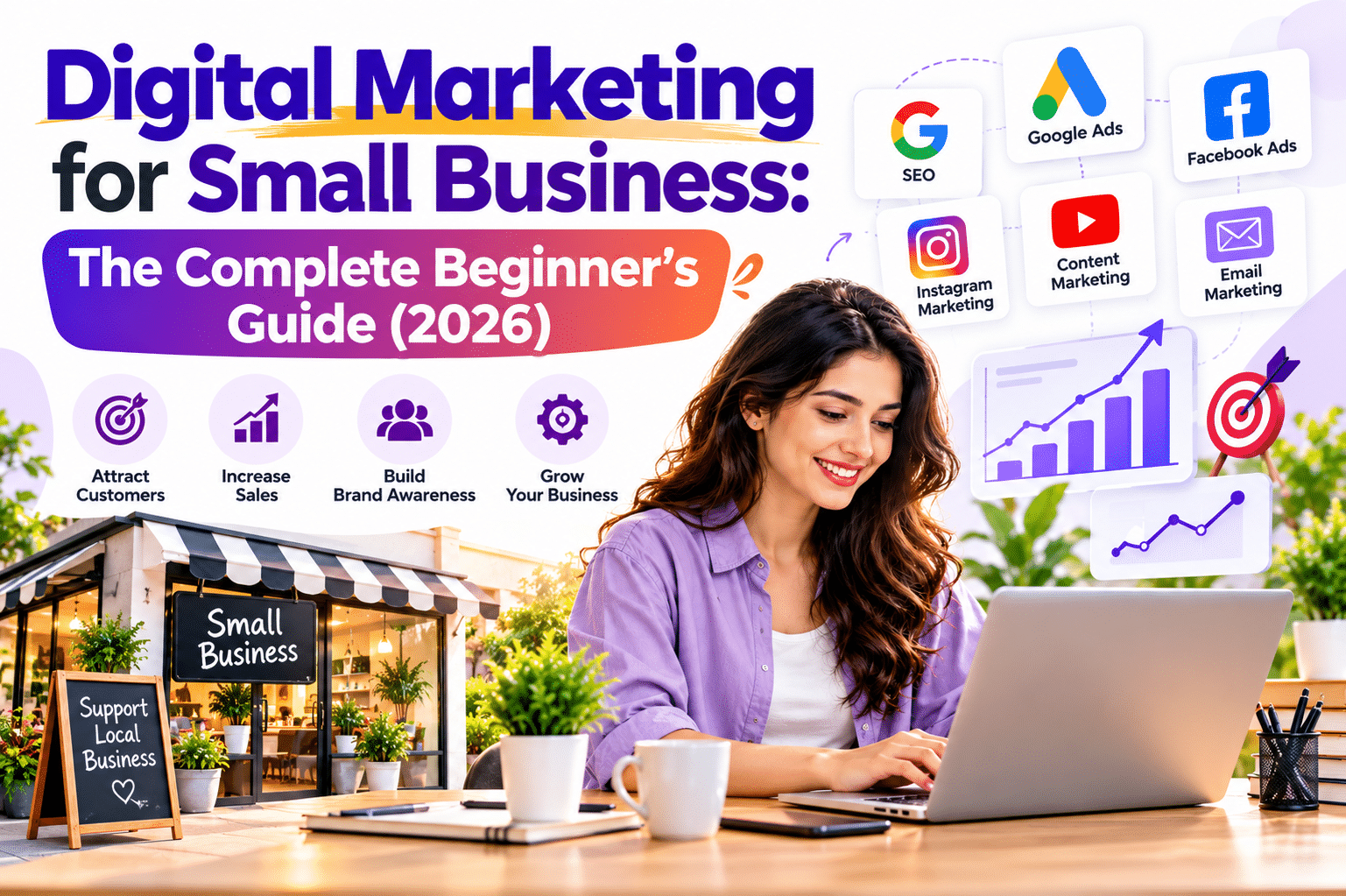
Starting an online presence can feel overwhelming when you are managing customers, sales and day-to-day operations at the same time. Digital marketing for small business provides a practical way to reach potential customers through search engines, websites, social media, email and paid advertising without depending entirely on traditional promotion.
What matters is not participation in every medium but rather having an understanding of one’s target market and choosing platforms that align with one’s objectives while ensuring that such efforts produce tangible inquiries, sales, or bookings.
As a novice, the most crucial step is laying the groundwork. A professional website, proper positioning, relevant content, search presence, and sound analytics will provide a solid foundation for your future marketing efforts.
Key Takeaways
- Define your business goals before choosing marketing channels.
- Understand what your ideal customers search for and need.
- Build a fast, mobile-friendly and conversion-focused website.
- Use SEO to develop sustainable organic visibility.
- Focus on local search if your business serves specific locations.
- Select social media platforms based on your audience.
- Use paid advertising when you have a clear conversion path.
- Create content that answers genuine customer questions.
- Track leads, sales and other meaningful actions.
- Review performance regularly and invest more in what works.
What Is Digital Marketing for Small Businesses?
Online Marketing is the process of promoting an organization through the use of the Internet as a medium of communicating with prospective clients, in order to generate actions like making inquiries, buying products, booking services or signing up for newsletters.
A simple customer journey can look like this:
Search or social media → Website → Product/service page → Enquiry or purchase → Follow-up → Repeat customer
The exact journey will vary depending on the business.
For example, an ecommerce company may focus on product discovery and checkout conversions, while a local service provider may primarily want phone calls, form submissions or appointment bookings.
The important point is that every channel should support a clear business objective rather than operate independently.
Why Small Businesses Need a Digital Strategy
Smaller firms may not have sufficient funds or large marketing teams. By having a focused strategy, they can ensure that their efforts are concentrated in areas where their target customers are rather than everywhere.
A well-planned approach can help a business:
- Increase online visibility
- Generate qualified website traffic
- Reach customers in specific locations
- Build brand awareness
- Generate enquiries and leads
- Increase ecommerce sales
- Improve customer retention
- Understand which campaigns produce results
Google’s current Search guidance recommends creating helpful, reliable, people-first content rather than producing pages primarily to manipulate rankings.
That principle is particularly useful for small businesses because every piece of content should have a genuine purpose for the customer.
How to Create a Digital Marketing Strategy
A beginner-friendly approach should begin with the business goal and not with the social media network or ad format. After identifying the objective, you can choose the right audience, medium, content, and measurement method.
Step 1: Define Your Goal
Choose a specific outcome, such as:
- Generate 30 qualified leads per month
- Increase online sales by 20%
- Get more local enquiries
- Increase repeat purchases
- Launch a new service
- Build awareness in a new market
Step 2: Identify Your Audience
Understand:
- Who are your ideal customers?
- What problem are they trying to solve?
- What do they search for?
- Which platforms do they use?
- What objections stop them from buying?
- What information do they need before making a decision?
Step 3: Choose Your Channels
You do not need every channel.
| Business Type | Suitable Channels |
| Local service provider | Search, local SEO, paid search |
| Ecommerce business | SEO, social media, paid ads, email |
| B2B company | SEO, content, LinkedIn, email |
| Restaurant | Local search, social media |
| SaaS business | SEO, content, paid search, email |
Step 4: Create a Conversion Path
Every campaign should have a logical next step.
For example:
Google search → Service page → Contact form → Sales call
Or:
Social post → Product page → Checkout → Purchase
Driving traffic without a clear conversion path can create activity without meaningful business results.
Small Business SEO
Small business SEO is the process of improving a smaller company’s website and online presence so relevant customers can discover it through organic search. It can be especially useful for businesses targeting specific products, services, industries or geographic areas.
Words that people use when searching should be employed on the page in places where they stand out and help describe what the page is about.
Keyword Research
Start by identifying searches related to your products or services.
For example, a home renovation company could research:
- Home renovation services
- Kitchen renovation
- Bathroom renovation
- House renovation company
- Home renovation cost
Look for a combination of high-intent commercial terms and informational searches.
On-Page SEO
Review:
- Page titles
- H1 and H2 headings
- Meta descriptions
- URLs
- Internal links
- Image ALT text
- Product descriptions
- Service pages
Content Strategy
Consistent, useful content can also be supported through professional content writing services designed around search intent and customer needs.
Examples:
- How much does a website redesign cost?
- What does a home renovation include?
- How long does an SEO campaign take?
- What should you look for in a digital marketing agency?
Content should provide a useful answer rather than simply repeat a keyword.
Technical SEO
Your website should also be:
- Mobile-friendly
- Secure
- Crawlable
- Easy to navigate
- Fast enough to provide a good user experience
- Structured logically
Google’s developer guidance specifically recommends websites that are secure, fast, accessible and functional across devices.
Local SEO for Small Businesses
Local SEO for small business helps companies improve visibility when customers search for products or services in a specific geographic area. It is particularly useful for businesses such as restaurants, clinics, agencies, retailers, contractors and professional services.
Important areas include:
- Google Business Profile
- Accurate business information
- Local landing pages
- Customer reviews
- Business directories
- Location-specific content
- Consistent contact information
For example, a company serving Jaipur may benefit from pages targeting relevant services in Jaipur instead of trying to rank nationally for every keyword.
Your local profile should accurately represent:
- Business name
- Address or service area
- Phone number
- Website
- Business category
- Opening hours
- Services
- Photos
Reviews can also help prospective customers assess whether they can trust a local business.
Social Media Marketing for Small Businesses
Social media marketing for small business works best when the content has a clear purpose. A business does not need to publish constant promotional posts to remain visible.
Businesses that need a structured approach can also consider professional social media marketing services to manage content, engagement and audience growth.
Educational Posts
Share tips, tutorials, checklists and answers to frequently asked questions.
Product or Service Demonstrations
Illustrate how the product works or demonstrate how the service can solve a specific problem.
Customer Stories
Use testimonials, reviews and case studies to demonstrate real experiences.
Behind-the-Scenes Content
Introduction to your group, process, workplace, or product development.
Promotional Content
Share discounts, launches, seasonal offers and announcements when they are genuinely relevant.
Choose a platform that suits your targeted audience. For instance, Instagram will suit an ecommerce company that relies heavily on visuals while LinkedIn suits a B2B company.
Small Business Advertising
Small business advertising can help companies reach potential customers faster than relying exclusively on organic channels. However, paid campaigns should be connected to clear goals and measurable conversions.
Common advertising channels include:
| Channel | Common Use |
| Google Search Ads | Capture high-intent searches |
| Google Shopping | Promote ecommerce products |
| Meta Ads | Discovery and audience targeting |
| LinkedIn Ads | B2B campaigns |
| YouTube Ads | Video awareness |
| Display Ads | Retargeting and awareness |
Before launching an advertising campaign, define:
Objective → Audience → Offer → Landing Page → Conversion → KPI
For example:
Objective: Generate qualified enquiries
Audience: People searching for a specific service
Landing page: Dedicated service page
Conversion: Completed enquiry form
KPI: Cost per qualified lead
Do not always measure the success of your campaign by how many clicks you get. It may well be that the campaign which attracts fewer clicks is more beneficial to your business.
Small Business Marketing Ideas That Are Practical
Small business marketing ideas should be selected according to your audience, budget and business model rather than simply following trends.
Consider testing:
- Customer referral programmes
- Educational blog content
- Short-form videos
- Local partnerships
- Customer testimonials
- Email newsletters
- Downloadable guides
- Seasonal campaigns
- Case studies
- Product demonstrations
- Free consultations
- Location-specific landing pages
For example, a local fitness business can write about workouts for beginners, collect customer testimonials, work with other firms in the locality, and advertise to people who are looking for fitness services.
The best idea is usually the one that connects directly to a customer need and has a realistic path to conversion.
Online Marketing for Small Business
Online marketing for small business becomes more effective when different channels work together rather than operating as separate activities.
For example:
SEO can attract people searching for answers.
Content can educate them.
Social media can build familiarity.
Paid advertising can capture high-intent demand.
Email can support retention and repeat purchases.
This creates a connected customer journey.
The small business does not need much technology set up. Begin with just the website, analysis, SEO and any channels that make sense for your audience.
Website and Conversion Optimisation
Your website is frequently the stage where marketing efforts are transformed into business actions. Should the visitors be unable to comprehend what you have to offer or how to proceed, more traffic might not necessarily help.
Review the following:
- Clear value proposition
- Easy navigation
- Mobile usability
- Visible calls to action
- Simple enquiry forms
- Trust signals
- Customer reviews
- Relevant service or product information
- Fast-loading pages
- Secure checkout or enquiry process
For service businesses, make the contact process simple.
For ecommerce companies, reduce unnecessary steps between product discovery and checkout.
The website should answer three basic questions quickly:
What do you offer?
Why should I trust you?
What should I do next?
How Much Should a Small Business Spend?
Each business is different and therefore, there cannot be a standard budget for all small firms. The perfect budget depends on revenue, profitability, competitive situation, cost of obtaining customers and expansion.
Instead of selecting a random percentage of revenue, consider the economics of acquiring a customer.
A simple framework is:
Customer value → Target acquisition cost → Required customers → Marketing investment
For paid advertising, start with a controlled test budget and measure qualified conversions before scaling.
SEO and content should be planned with the understanding that organic visibility typically needs continual effort as opposed to being a one-time task.
A balanced budget might include:
| Activity | Primary Purpose |
| SEO | Long-term organic visibility |
| Content | Education and discovery |
| Social media | Engagement and awareness |
| Paid advertising | Demand capture |
| Retention | |
| Website optimisation | Conversion improvement |
How to Measure Digital Marketing Performance
Measurement should focus on actions that matter to the business. Track traffic, but do not stop there.
Important metrics may include:
- Leads
- Sales
- Conversion rate
- Cost per lead
- Customer acquisition cost
- Return on ad spend
- Average order value
- Revenue by channel
- Repeat purchase rate
Key events are considered by Google Analytics for actions that are critical to business success; whereas conversions may be considered for important actions to measure and optimize advertising campaigns.
This distinction makes it easier to connect website behaviour with actual business outcomes.
Common Digital Marketing Mistakes
- Trying to Be Everywhere: Focus on platforms where your audience is most active.
- Focusing Only on Traffic: Prioritise leads, sales and qualified enquiries.
- Ignoring Local Search: Target customers in your specific service area.
- Publishing Without a Purpose: Create content that supports clear business goals.
- Sending Every Visitor to the Homepage: Use relevant landing pages for campaigns.
- Not Tracking Conversions: Measure leads, sales and other key actions.
- Expecting Immediate SEO Results: Give SEO time and maintain consistent optimisation.
90-Day Beginner’s Marketing Plan
| Period | Focus | Activities |
| Days 1–30 | Foundation | Website audit, audience research, keyword research, analytics |
| Days 31–60 | Visibility | SEO content, local optimisation, social content |
| Days 61–90 | Growth | Paid campaign tests, landing-page improvements, conversion analysis |
Days 1–30: Build the Foundation
Establish analytics, analyze your website, know your audience and find appropriate keywords to use in searches.
Days 31–60: Increase Visibility
Write helpful content, enhance key web pages, increase local awareness and follow a social media routine.
Days 61–90: Test and Optimise
Test your paid campaigns, analyze your conversion metrics, fix your low-performing landing pages, and allocate more budget to high-performing channels.
FAQs
1. What is digital marketing for small business?
It includes the use of online media like search engines, websites, social networking sites, e-mails, and advertisements for the purpose of generating customers.
2. What is the best marketing strategy for a small business?
Establish clear objectives, a powerful web presence, and channels that will reach your intended audience.
3. Is SEO worth it for a small business?
Yes, SEO can build long-term organic visibility and attract customers actively searching for your products or services.
4. How can small businesses get customers from social media?
Apply effective content, product demonstrations, customer testimonials, videos, and appropriate promotions to lure potential customers.
5. How much should a small business spend on advertising?
Start with a manageable budget and increase spending when campaigns consistently deliver profitable results.
6. How long does SEO take for a small business?
SEO needs patience because it is dependent on competition, quality of the website, content, authority and search demand.
7. Should a small business use Google Ads and SEO together?
Yes, combining paid search with SEO can capture immediate demand while building long-term organic visibility.
8. What should a small business measure?
Track qualified leads, sales, conversion rate, customer acquisition cost, revenue and return on advertising spend.
Conclusion
A strong digital marketing for small business plan is not about being active everywhere. It is about choosing the right channels, reaching the right audience and turning online attention into meaningful enquiries and sales.
From search and social media to local visibility, content and paid campaigns, every activity should have a clear purpose and measurable outcome. Shag Infotech helps businesses bring these efforts together through SEO, AEO, GEO, AI SEO, web design and digital marketing services, creating practical strategies that support long-term online growth.