

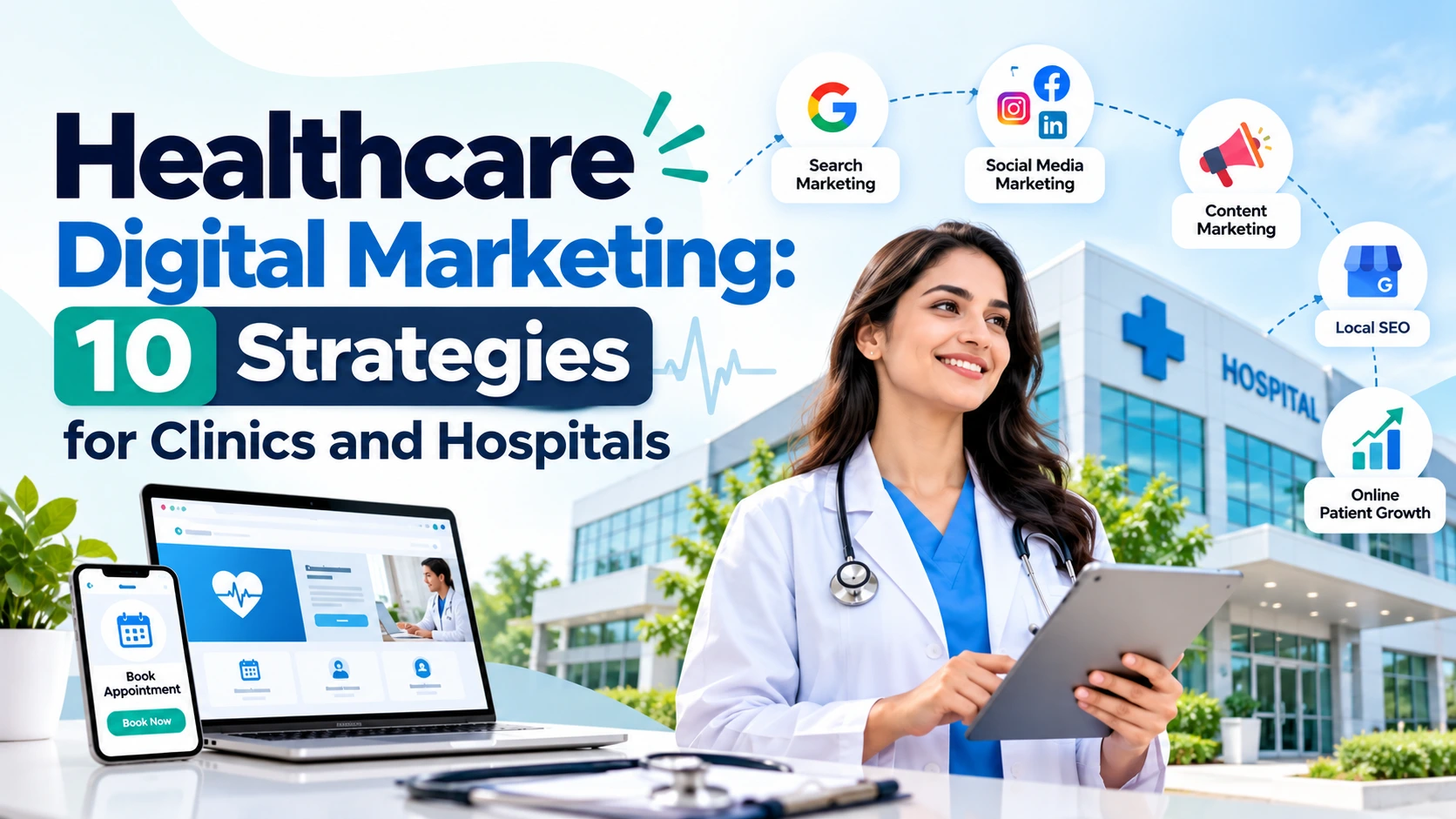
Often, people seek out information on different medical professionals, clinics, and hospitals online prior to scheduling their appointments. They analyze medical services offered, patient reviews, location, and other healthcare related information. The healthcare digital marketing is used by medical professionals for finding their potential patients online.
A healthcare digital marketing agency can help clinics and hospitals improve online visibility, build patient trust, and attract relevant enquiries. By focusing on accurate information, patient privacy, and a user-friendly experience, healthcare providers can strengthen their digital presence and connect with the right audience.
10 Healthcare Digital Marketing Strategies for Clinics and Hospitals
These 10 marketing ideas will help clinics and hospitals increase online visibility, gain patients’ trust, and generate inquiries.
1. Create a Patient-Friendly Website
The website is the first point of contact for the patients in relation to your organisation and must ensure that necessary information is easily accessible.
Include:
- Medical services, specialities, and treatment information.
- Doctor profiles and verified qualifications.
- Clinic locations, consultation hours, and contact details.
- Appointment booking options and frequently asked questions.
The website should be optimized for mobile usage, be secure, accessible, and user-friendly. Loading time of pages as well as functionality of the contact forms should be checked. Booking system should be simple enough to make people understand how to contact you.
2. Invest in Healthcare SEO Services
Search engine optimisation (SEO) helps your website appear in relevant search results. For healthcare providers, this may include searches for medical specialities, treatments, and nearby clinics.
Effective healthcare SEO services begin with understanding what potential patients search for and creating useful pages that answer those queries.
For example, a dental clinic can create separate pages for dental implants, root canal treatment, and routine check-ups instead of placing every service on one page.
Focus on three areas:
- On-page SEO: Improve page titles, headings, URLs, and service descriptions.
- Technical SEO: Address loading speed, mobile usability, indexing, and website structure.
- Local SEO: Maintain accurate business details and improve visibility for location-based searches.
Use medical keywords naturally and prioritise accurate, helpful information over keyword repetition.
3. Optimise Your Google Business Profile
People often look for medical professionals close to their vicinity and hospitals. Having an optimized Google Business Profile can make sure that your organization shows up on these searches.
To improve your local presence:
- Keep your business name, address, phone number, and hours accurate.
- Choose appropriate business categories.
- List relevant services and add genuine facility photographs.
- Update holiday hours and other important changes.
- Monitor reviews and respond professionally.
Healthcare organisations with multiple locations should maintain accurate profiles for eligible locations. Never use misleading addresses or create duplicate listings to manipulate search visibility.
4. Publish Medically Reviewed Content
Information seekers include patients seeking symptom, treatment, prevention, and procedure-related information. Publishing information helps satisfy frequent queries and provides support to have informed discussions with health practitioners. Think of content like preparation for a diagnosis, a dental procedure, or the experience of a first-time visit.
Healthcare content needs to be evaluated by an appropriately qualified individual, particularly if it involves diagnosis, treatment, risk, or recovery. Credentials of author or reviewer must be shown and updated where necessary according to new guidelines. Be careful not to promise cure or treatment for everyone. Information content should inform but not replace personalized healthcare advice.
5. Use Social Media to Educate Patients
Through social media, the clinics and hospitals will be able to post information about education, introduce their staff, and give updates on services.
Select your platform based on your intended audience and type of content. Instagram and YouTube can help with video education, and Facebook can help with community-related information.
Useful content ideas include:
- Short videos explaining common medical terms.
- Introductions to doctors and their verified qualifications.
- Preventive care reminders and awareness campaigns.
- Facility tours and appointment instructions.
- Answers to frequently asked general health questions.
Maintain a realistic posting schedule and keep information accurate. Obtain appropriate consent before publishing patient stories or photographs. Never reveal personal health information when replying to comments or messages.
6. Run Targeted Healthcare Advertising Campaigns
These methods may be used by healthcare organizations to target their customers and offer special services.
As an illustration, a clinic can advertise a consultation of dermatologist in its service area. The landing page must cover all the aspects of the service offered including conditions, booking process, and location.
Before launching a campaign:
- Establish objectives such as appointment requests.
- Investigate keywords and geographical locations for searches.
- Design landing pages for advertised services.
- Set a budget and establish a request processing protocol.
- Verify the guidelines and laws of the advertising system.
Measure qualified enquiries and completed booking actions rather than clicks alone. Healthcare advertising may involve restrictions on sensitive targeting, personal health information, and medical claims.
7. Manage Online Reviews and Reputation
Online reviews influence how people compare healthcare providers. Professional responses can demonstrate that your organisation takes feedback seriously.
Encourage patients to share honest feedback voluntarily, without pressure or misleading incentives.
When responding to reviews:
- Acknowledge reviewers where appropriate.
- Ensure that responses remain respectful and professional.
- Do not confirm the identity of patients.
- Never reveal diagnoses, appointment dates, or treatment plans.
- Individual issues should be handled via a private medium.
Do not purchase reviews or publish fabricated testimonials. Ratings can inform a patient’s decision, but they do not independently establish clinical quality.
8. Use Email Marketing Responsibly
Email marketing allows healthcare organisations to communicate with those individuals who have subscribed to receive pertinent information.
A good email strategy would comprise appropriate information, subject headings, correct contact databases, and a method for unsubscribing from marketing communications.
Appointment reminders may also be used as communication means when used effectively. Make sure that your messages are not too open because it is possible that shared devices or accounts will be used.
Check all consent and privacy issues before initiating any campaign. Make use of appropriate security measures and do not rely on patient relationships to use any form of marketing.
9. Simplify the Appointment Booking Process
The aim of attracting visitors to your website is only the beginning of the process involved in healthcare marketing. What follows next is making it easier for your visitors to contact you or schedule their appointment with you.
Consider how the process flows from visiting your website through to booking an appointment. Strip away any superfluous form fields, show your contacts prominently, and provide clarity about what happens next.
Consider offering:
- Online appointment requests or booking options.
- Click-to-call links for mobile visitors.
- Clear directions and parking information.
- Accessible forms with understandable instructions.
- Confirmation messages and appropriate follow-up.
Collect only the information needed for the stated purpose. Medical information submitted through forms requires suitable security and privacy safeguards.
10. Track Performance and Improve Results
Measuring marketing performance helps clinics and hospitals understand which activities attract relevant enquiries and where improvements are needed.
Track metrics such as:
| Metric | Purpose |
| Organic search traffic | Measures visits from search engines |
| Local profile interactions | Tracks calls, directions, and website visits |
| Qualified enquiries | Measures relevant prospective patient enquiries |
| Appointment conversions | Shows how often enquiries lead to bookings |
| Cost per enquiry | Evaluates paid campaign efficiency |
| Landing-page performance | Identifies potential barriers to action |
Use appropriate analytical tools and measures to protect your privacy. Do not reveal any sensitive personal data using links, tracking pixels or analytics events.
Regularly review your results and adjust your tactics according to their outcomes. If your campaign has brought you lots of visits but very few inquiries, you may need some adjustments.
Conclusion
The healthcare industry digital marketing involves the combination of relevant information, local search optimization, patient-oriented websites, and responsible communication. The clinic or hospital should begin by enhancing the important website information, optimizing locally, and recording significant inquiries.
At Shag Infotech, we help businesses improve their online presence through digital marketing and SEO solutions. Visit Shag Infotech to learn about our services and discuss a strategy aligned with your organisation’s goals.
Ready to Strengthen Your Healthcare Digital Presence?
Get help with reaching out to potential patients through the appropriate digital marketing plan for your clinic or hospital. Shag Infotech provides SEO services, social media marketing, content marketing and digital advertising to enhance online presence and generate quality leads.
🌐 Website: https://shaginfotech.com/
📧 Email: info@shaginfotech.com
📞 Phone: +91 70739 63323
Contact Shag Infotech today to discuss your digital marketing goals and build a strategy tailored to your healthcare organisation.
Frequently Asked Questions
1. What does a healthcare digital marketing agency do?
It assists healthcare practitioners in improving SEO, marketing, social media, and online presence.
2. Why is healthcare SEO important?
It helps patients find relevant medical services through search engines.
3. Which marketing strategy works best for hospitals?
These include local SEO, education material, paid advertising, and reputation management.
4. How can small clinics improve online visibility?
Optimize Google Business Profile, create valuable content, and get authentic reviews.
5. How can healthcare providers measure marketing success?
Track website traffic, enquiries, appointments, conversion rates, and advertising costs.