


Companies engage in online marketing to attract customers, gain exposure, and sell their products. But all types of marketing do not achieve the same objective. Some marketing efforts are made for the sake of gaining brand exposure, while others are meant to get leads or registrations immediately.
The difference between performance marketing and digital marketing can help companies adopt proper marketing techniques.
If you are researching performance marketing agency definition services, it is important to understand how these services differ from broader digital marketing activities.
While both strategies involve online tools, they have differing goals, measures, and schedules. The distinctions between the two, the advantages and disadvantages of each, and ways they can be applied are discussed in this article.
What Is Digital Marketing?
Online marketing includes the process of promotion of goods, services and brands via digital mediums like search engines, websites, social networks and emails.
Some of its objectives may include brand recognition, generating visitors for the website, engagement of audience and generating inquiries/sales.
Common Types of Digital Marketing
- Search Engine Optimisation (SEO): Improves organic website visibility.
- Content Marketing: Creates useful blogs, videos, and guides.
- Social Media Marketing: Builds audience engagement through social platforms.
- Email Marketing: Communicates with existing and potential customers.
- Paid Advertising: Promotes products and services through online advertisements.
In this regard, an example could be of a clothes company publishing fashion blogs, posting on Instagram, and sending email promotions.
Digital marketing supports both short-term campaigns and long-term brand development.
What Is Performance Marketing?
Performance marketing is an approach to digital marketing that prioritises measurable actions such as clicks, leads, purchases, and registrations. Businesses use campaign data to evaluate advertising expenses and improve results.
Common performance marketing services include Google Ads, paid social media campaigns, conversion tracking, audience targeting, and landing page optimisation.
In other words, the online furniture company can advertise a certain collection of its products and assess the number of sales that advertisements have brought. Performance marketing is not always about payment per sale. The advertising platform may be charged per click or impression, even if campaigns are conversion-oriented.
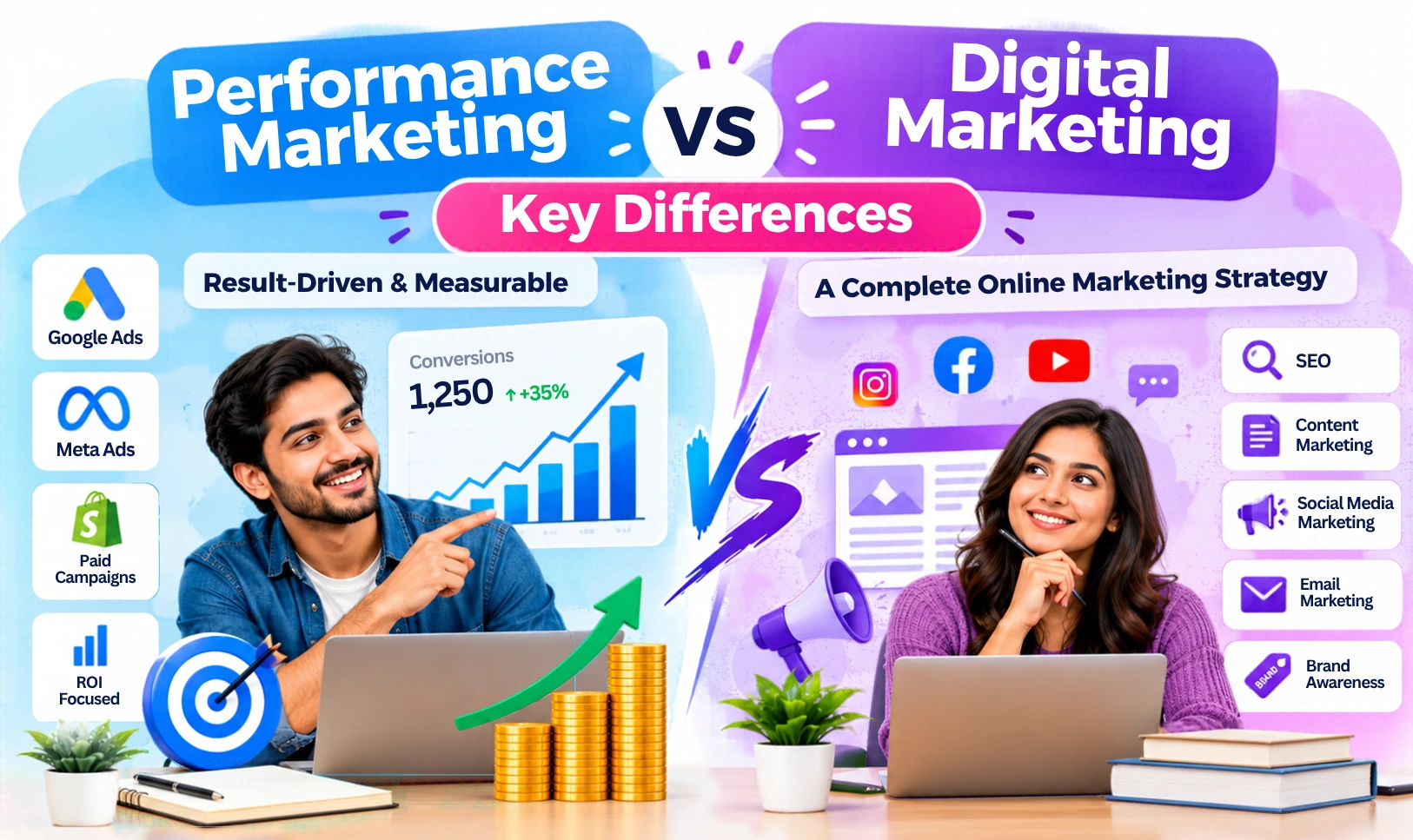
Performance Marketing vs Digital Marketing: Key Differences
Although both approaches use online platforms, they differ in campaign objectives, measurement priorities, and resource allocation.
| Comparison Factor | Digital Marketing | Performance Marketing |
| Primary Goal | Brand awareness, engagement, traffic, and sales | Measurable leads, conversions, and sales |
| Main Channels | SEO, content, social media, email, and paid ads | Paid search, paid social, affiliate campaigns |
| Key Metrics | Traffic, reach, engagement, conversions | CPC, CPL, CPA, ROAS |
| Budget Approach | Ongoing marketing and campaign investment | Budget allocation based on campaign performance |
| Timeline | Short-term and long-term activities | Frequently focuses on measurable campaign outcomes |
| Optimisation | Content, audience engagement, and channel performance | Ads, targeting, landing pages, and conversion costs |
| Best For | Building an overall online presence | Improving measurable acquisition results |
Performance marketing is part of digital marketing rather than a completely separate category.
Key Benefits of Digital Marketing
Digital marketing enables organizations to interact with their customers during their purchase process.
1. Builds Brand Awareness
Consistent website content, social media activity, and search visibility help potential customers become familiar with a business.
2. Supports Long-Term Organic Traffic
SEO and informative content can continue attracting relevant visitors after publication, although rankings and traffic are never guaranteed.
3. Improves Customer Engagement
Social media, email campaigns, and educational content allow businesses to answer questions and maintain customer relationships.
4. Offers Multiple Marketing Channels
Marketing campaigns can choose the medium based on the audience, available budget, and marketing goals of the campaign.
Yet, organic marketing activities might take some time to bear fruit.
Key Benefits of Performance Marketing
Performance marketing focuses on connecting campaign spending with measurable business actions.
1. Tracks Campaign Results
Businesses can measure enquiries, purchases, registrations, and other valuable customer actions.
According to Google Ads conversion tracking guidance, conversion tracking helps advertisers understand which advertisements contribute to valuable actions
2. Supports Budget Decisions
Campaigns will provide data to marketers to help identify advertisements and audiences that work effectively.
3. Improves Audience Targeting
Advertisers can reach audiences based on relevant search intent, demographics, and supported targeting options.
4. Enables Campaign Testing
Companies can benchmark their ads, headlines, and landing pages in order to make adjustments.
Nevertheless, the cost of advertising can be increased by means of rivalry or inefficient targeting/ conversion.
Important Performance Marketing Metrics
Businesses should understand the following measurements before investing in paid campaigns.
| Metric | Meaning |
| CPC | Cost per click on an advertisement |
| CPL | Average advertising cost per lead |
| CPA | Average cost per defined acquisition |
| CTR | Percentage of impressions resulting in clicks |
| Conversion Rate | Percentage completing a desired action |
| ROAS | Revenue attributed to ads divided by ad spend |
| ROI | Return relative to overall investment costs |
For example, if a business spends ₹20,000 on advertising and generates ₹80,000 in attributed revenue, its ROAS is 4:1.
ROAS does not consider all the costs that a business incurs. Other factors include cost of production, overheads, and many others.
Role of Performance Marketing in eCommerce Businesses
Ecommerce performance marketing focuses on attracting shoppers and encouraging measurable purchases through online advertising.
For instance, an e-commerce business selling skincare products could market their products through Google Shopping Ads and Instagram Ads. They will be able to measure their purchases, ad costs, and conversion rate.
An appropriate marketing plan would include product ads, audience testing, remarketing where possible, and improving landing pages.
Successful marketing campaigns require correct product information, competitive pricing, and good usability.
Choosing Between Digital Marketing and Performance Marketing
The right approach depends on your business objectives. Digital marketing is useful when your priority is building awareness, developing organic visibility, and maintaining customer relationships.
Performance marketing is particularly relevant when you want to track lead generation, customer acquisition, or sales against advertising expenditure. Businesses looking for an ROI-focused ad agency should evaluate reporting transparency, conversion measurement, campaign strategy, and understanding of business profitability.
Can Digital Marketing and Performance Marketing Work Together?
Yes. Utilizing both of these strategies may be helpful for companies to attract their prospective customers and make them convert.
As an illustration, an e-commerce company dealing in fashion products can create SEO optimized blogs to drive organic traffic, post content on social media, and also conduct advertisement campaigns to promote particular products.
At Shag Infotech, we suggest selecting marketing activities depending on business goals, budget limits, and customer needs.
Frequently Asked Questions (FAQs)
1. What is the difference between performance marketing and digital marketing?
Digital marketing covers online promotional activities, while performance marketing focuses on measurable actions such as leads, purchases, and conversions.
2. What services does a performance marketing agency provide?
A performance marketing agency generally offers services such as paid advertising, audience targeting, conversion tracking, landing page optimization, and campaign reporting.
3. Is performance marketing better than digital marketing?
Neither is universally better; performance marketing prioritises measurable outcomes, while broader digital marketing supports awareness, engagement, and customer acquisition.
4. Is performance marketing suitable for eCommerce businesses?
Indeed, the eCommerce business can leverage performance marketing for promoting their products and also measuring the cost of advertising.
5. How is ROI measured in performance marketing?
ROI is calculated on the basis of net gains divided by total cost of investments, whereas ROAS calculates revenues earned through advertising divided by cost of advertising.
Conclusion
An understanding of both performance marketing and digital marketing is necessary when making the right marketing strategies. The two methods help achieve brand awareness, customer engagement, and visibility, while performance marketing looks at the results of any campaign. Both methods may be used simultaneously to reach the right audience and make better decisions on marketing. Shag Infotech plans out digital marketing activities according to the business goals, target audience, and resources.
Ready to Improve Your Digital Marketing Performance?
Reach potential customers and make informed marketing decisions with a strategy tailored to your business. Shag Infotech provides performance marketing services, SEO, social media marketing, content marketing, and digital advertising to improve online visibility and support lead generation.
🌐 Website: shaginfotech.com
📧 Email: info@shaginfotech.com
📞 Phone: +91 70739 63323
Contact Shag Infotech today to discuss your digital marketing goals and develop a strategy focused on measurable business outcomes.